Wednesday, April 14, 2010


The Western has attracted several star & director teams, starting with Wayne & Ford, (and Wayne & Hawks) Stewart & Mann, and even Eastwood & Leone and Eastwood & Siegel (although the latter produced as many cop thrillers as Westerns). The most recent pairing to enter the auteurist pantheon is the seven Westerns starring Randolph Scott (who had already been a star for 25 years) directed by Budd Boetticher between 1956 and 1960. I've just viewed the second one made, the first currently available in home video, a tense, tight chamber piece mysteriously called The Tall T (1957). (Literally mysteriously-- there is no evident explanation for that title from anything in the film, or indeed, the Elmore Leonard story it is based on, which was called "The Captives.")

As is always mentioned, Boetticher learned bullfighting as a young man, but the reason it's always mentioned, is that it seems to have informed his entire approach to storytelling--the idea of the inescapable test of will and nerve, the man in the arena, as Teddy Roosevelt would have it.
whose face is marred by dust and sweat and blood; who strives valiantly; who errs, who comes short again and again, because there is no effort without error and shortcoming; but who does actually strive to do the deeds...
In The Tall T the arena has a physical representation, in the form of the cramped space at the base of an outcropping of rocks sheltering a small shack in which the film spends its last two-thirds. Where so many Westerns make use of the vast expanses--Ford and Monument Valley, Stewart riding across all sorts of wastelands in search of justice or vengeance, Boetticher ratchets everything down to a space that could fit on a stage in a theater.

But by then you already knew this Western was different because **SPOILER ALERT**, 28 minutes into the picture, he KILLS OFF THE COMIC RELIEF, in this case the craggy Arthur Hunnicutt (who seems like Walter Brennan as a college professor who dropped out of the system). Perhaps you have to know this genre well to know what a radical thing this is. The film starts off, pleasant and pastoral, clearly a Saturday-afternoon movie, as genial sunburned Randoph Scott greets a little boy (representing much of the potential audience) and his goodnatured dad at the coach station. They too, will be killed by the baddies--in fact, even before funny old Arthur Hunnicutt. Nearly all the people that our hero is friendly with and can rely on--all the stable welcoming touchstones in his small circle are gone. Don't know about you, but I think that's going to push a man to the edge.

The next thing that is striking about this movie is the warm, seductive Richard Boone as the villain. Not warm and seductive like an oily conman. A genuinely likeable guy who never actually shoots any of the good guys. He has too juvenile delinquent psychos to do that. Boone spends most of the movie trying to cuddle up to Randolph Scott, trying to get Scott to like him, trying to show how he is just like Scott.

Randolph Scott is not a fashionable cult movie star (except to cinema cuckoos who've delved deep into these Scott-Boetticher movies). John Wayne was more colorful and varied, more given to flawed heroes, Gary Cooper sexier, James Stewart more neurotic. Randolph Scott was just a stand-up Southern gentleman, and thus the perfect representative of our American ideals to put to the test in confrontations with evil. His taciturnity is not an affectation, or a suggestion that he was simple, but simply a measure of reserve that originates not just from good manners, but from a genuine conviction that the less said, the better. (This is why it's good for Scott's antagonists, like Boone, to be chatty.) Incidentally, because he was born in Virginia, film writers are always talking about his Virginia accent, but anyone who knows the area recognizes the substitution of "oi" for "er" as pure North Carolina, which is where Scott grew up.

So Boetticher and screenwriter Burt Kennedy have cleared away everything extraneous, and the stage is set for a confrontation between good and evil. And unlike other Western heroes, Scott has already admitted he is afraid and he has no plan. Maureen O'Sullivan, the other surviving hostage passes briefly through hysteria, but Scott coaxes her out of it by getting her to acknowledge her own self-worth, an assessment he reinforces by planting a big one right on the kisser. Incidentally, in deference to both the gentleman Randolph Scott and the boys in the audiences who don't go for all that mushy stuff, that one kiss suffices--and given its fervor, it damn well ought to.

The final confrontation rests on one piece of knowledge the viewer must have about the code of Classical Westerns. The good guy will Never Shoot Anyone In The Back, Even the Baddest of Bad Guys. Naturally, this boxes our hero in; and the baddie would have gotten away scot-free, if not done in by his own greedy impulse. Scott does what he has to, but in sorrow, not in anger. Then he tells Maureen it's going to be a good day, and so I think perhaps it will be.

The difficult thing about the Scott-Boetticher Westerns is that none of them qualify as all-time great films, or even all-time great Westerns. But they are all solidly built, sure, specific, drawn from character, and always dealing with clear moral dilemmas and moral tests. It is as a group they are significant. It's a bit like trying to identify the one great Chopin etude or the single great Raymond Carver story. It's not any one of the works, but the totality which shows a clear world view clearly expressed.

Looking forward to seeing and writing about the next one soon.

Tuesday, April 13, 2010

Yin and yang on the runway


The publicity for The September Issue (2009) all focused on Vogue's famous editor, Anna Wintour (on the right). But the film tells quite a different story. It is about the tense and productive partnership between Wintour and her chief stylist and creative force on the magazine, Grace Coddington (on the left here). Together, they are the Lennon and McCartney of fashion publishing, each self-sufficient, yet each needing the other to complete themselves creatively, making the other better, sharper, more inventive and continuing to lead their respective fields.

Naturally, the marketing promises a film about fashion, but it is really a film about collaboration, the nature of it, its difficulties and rewards. On a first viewing, the film is frustrating because it purports to reveal the process by which the keystone September issue of Vogue is put together. But the actual process is impossible to observe at first viewing. The film is a cineastes delight because there is so much to entertain the eye--color, design, form--and because these visual people communicate almost non-verbally. Shrugs, eyebrow tilts, mumbles--these are the way messages are delivered. If you are looking for someone to explain, "This person begins an article by doing this, and then these people get together and do that..." you will be disappointed. How this immense thing comes together is nearly as mysterious when the film is over as when it started.

Along the way is a huge amount of detail, more than can be assessed in a single viewing. Take any scene in this film and count the number of shots, especially the cutaways. The fact is, that cutaways are used to abridge scenes that ramble on in real life and need to be given economy and shape in the finished film. But these cutaways are so often to telling and unexpected details. Yes, of course, darting eyes, tapping fingers, lists being crossed off. But sometimes they cut to shoes, pictures on the wall, scenes outside the window--every bit of visual stimulus that could have an effect on the final product.

September Issue is a remarkably pure example of Direct Cinema. If you do not know what a collection is, what a stylist does, what couture is and how fashion journalism shapes it, this film will not make that clear to you. There is no narrator, and the only titles indicate the amount of time until the September issue closes. So you don't get explanation. What you do get is total immersion in this world, to the point where the filmmakers become part of the story, in an amusing final incident reminiscent of Albert Brooks's film Real Life.

Every detail of how Vogue makes it to your newsstand or mailbox may not be made crystal clear (for example, I have no idea what Andre Leon Talley, the third most important character in the film, actually does. He seems to just run around being amusing.) What is clear is the dynamic tension between the two principal figures, and that--plus the ticking clock until the closing date--makes a good movie story.

What do we mean by that?


What is really remarkable about Adam (2009) is not merely that a touching and entertaining romance can be built around Asperger syndrome, but the apparently effortless command and mastery by which writer-director Max Mayer employs Asperger as a metaphor for a whole range of adult relationships, and indeed, for the act of watching film. Before I go on, I need to tell you that this is not a "disease of the week" movie, or a plea for special understanding of a misunderstood population. It's simply a story about relationships in which one person has an inherent difficulty with relationships--not much different than all those movies about slovenly frat boys who don't understand women. Adam just doesn't understand anybody. And there is not a single dull or redundant moment in this highly engaging movie, beautifully shot by Seamus Tierney. (I was stunned when I learned this film was shot on hi-def video, not 35mm. The images are crisp and evocative, nothing like the dull, smeary look of Cold Souls.)

Many of the salient characteristics are Aspergers are phases that we all go through, especially as teenagers. Inability to look people in the eye, a low level of empathy (this is actually physically developing as the pre-frontal lobe is still growing and not completed until the late teens), difficulty understanding non-verbal communication, or indirect verbal modes such as irony and sarcasm--all of these can be puzzling to 14-17 year-olds. There are films from Classical Hollywood I have learned to shy away from in a high school film course, not because material is offensive or upsetting, but simply too difficult to decipher. Social and censorship codes of the 30s, 40s and 50s made it impossible to discuss some matters directly. I found myself stopping the film Casablanca to explain that when the young Bulgarian bride asks Rick what he would think of someone who does a bad thing for a good reason, she is asking him if she should sleep with Renault in order to get an exit visa for herself and her husband. So many films of this era--To Have and Have Not, Notorious, Gilda are reeking with sex which a teenager cannot detect because no one removes any clothing or says a dirty word.

But indirection, compression and the use of verbal and visual signals is often right smack at the heart of filmmaking. Look at the beginning of Adam. We see a young man at a funeral. We see him return to an overly-large apartment. He goes to a calendar marked with "Dad's Chores" and "Adam's Chores" and strikes out "Dad's Chores." Close-up on an American flag folded in a triangle, shoved onto a shelf. We know this young man has lost the father he lives with, that he is methodical and that the father was a veteran. All this in the space of seconds without dialogue. I wonder how readily someone with Aspergers would grasp the unspoken exposition of this very film.

And then there are relationships. How much do we ever understand what is in another's head? (This is one of my "commercials" for teaching literature in school--it is one of the few ways to approach the inside of another person's mind.) We try, we guess, we make mistakes, we ask forgiveness (or don't), we are forgiven (or not) and the success of relationships is often measurable by our tolerance for each other's stumbles.

It is hard to describe how satisfying and sure-footed this film is. Adam is not a saint, and not possessed of mystical knowledge. (Adam even makes a deft Forrest Gump joke, which takes his girlfriend a moment to recognize, so rare are his wisecracks.) Scenes are visually well-composed, the action well designed, beginning and ending at the right spot. One might take issue with the subplot, which has to do with our tolerance for deception from others, but I think it sheds light on the main thread of the story.

Also I liked the metaphoric use of children's stories, particular Le Petit Prince and The Emperor's New Clothes, which ties in nicely with Rose Byrne's character's desire to become a children's author; this in turn neatly wraps up the conclusion, which is satisfying without being pat. It is hard to believe someone with such a meager film resume can make something with such clarity, control and confidence.

One little side note--that satisfying conclusion is the result of studio involvement and focus groups, which helped pinpoint some audience dissatisfaction with the original ending. Hats off to Fox Searchlight for acquiring and distributing the film, but also helping make a positive artistic contribution.

Monday, April 12, 2010

An American life with no second act


I used to travel to France on business and I did not find the people slow or obtuse or having difficulty picking up on things. So why can French films be so slow? Cold Souls (2009), written and directed by French-born Sophie Barthes, has a pretty good joke to tell, but it tells it--slowly--then tells it again, then sort of loses interest in going on, flops around listlessly and stops.

Yes, the movie has ideas, or at least one, but it treats that idea like a shopper in a gift store, picks it up turns it around halfway, then puts it down and goes on shopping. At no time is the idea explored, developed, worked out, or even reversed. It's simply stated and we are all expected to sit back and congratulate a movie for having an idea.

The idea is that the soul is an extractable item, that it brings unbearable weight to some people, and that some people are happier without them. Yes, I know they should have brought Donald Trump and Paris Hilton on at this point, but no, they go to Russia, where everyone has "heavier" souls than Americans. This idea is presented without a speck of irony, as is the concept that Russians are either downtrodden plebes or gangsters.

Paul Giamatti plays an actor named Paul Giamatti, but strains credulity that an actor of that intelligence would imagine he could continue in his chosen field without a soul (unless of course he had a series on the WB). The self-referential aspect invites comparison with Charlie Kaufman's work, in which both John Malkovich and Nicholas Cage have played characters who have the same name and occupation as they do, inviting the audience to believe they are playing themselves. But Kaufman keeps pulling rabbits out of the hat, but this movie quickly becomes all hat and no rabbit.

A few examples: After Giamatti has his soul extracted, he has a terrible rehearsal playing Chekhov's Uncle Vanya as a manic narcissist, turning the role and the play into utter nonsense. Director Michael Tucker simply walks away in disgust, eschewing a chance to explore what's gone wrong. Giamatti immediately realizes the problem and begins trying to solve it (at first by renting another's soul). But what if Giamatti's career had taken off once his soul was extracted. At the moment he's a bit of a cult favorite. When he appears in a pop movie it is in a supporting role, perhaps as a villain. What if having no soul automatically makes you a star? Or what if he had to attend a family reunion with no soul? Would anyone notice? What would they see? The whole concept of being soulless is raised and then immediately dropped so that the film can go on a long tedious trip to Russia.

Why tedious? Because the pretty and marginally talented Russian actress who has had Giamatti's soul installed (under the impression that it is Al Pacino's--Al Pacino would never be so foolish as to have his soul extracted) does not seem to display any effect of having a different soul. Not that she fails at the task--the writer-director simply hasn't provided any opportunity to explore this idea. The whole thing makes no sense, because if her husband (who runs the black-market soul factory) can lie to her about the soul she is given, why bother using any American actor. Why not just grab the first unclaimed soul lying around, which would have saved a lot of money and effort. And we can't see that it makes any difference in the woman's behavior.

This goes to one of my complaints about films with strong abstract concepts--so many of them get caught up with the mechanics of their premise. So a great deal of the running time of the film is spent with soul-extracting machines and the containers the soul comes in and how the "mules" move in and out of the country, that the central concept of the film remains unexamined, and the characters have to spend immense amounts of time finding out information that we, the audience, already know.

Similarly, when Giamatti begins carrying around a Russian poetess' soul, a soul described as "beautiful," why doesn't Giamatti act on the promptings of that soul? Why doesn't he gain greater vision and insight of the world around him? Being sensitive to other souls doesn't seem to have any effect on Giamatti other than burdening him. The unaddressed question for the whole film is "What is the effect of the soul on human life? How does it make us different--from each other and from other types of life? If we are better off with souls than without, why?" At the end of the film, the young woman who has been acting as a "mule", carrying souls back and forth is left with an enormous residue from the souls she has carried. Wouldn't that give her real insight and vision? I don't know. She goes down to walk on the beach. Is that profound? I don't know.

Early in the film I remarked to my wife that this seems like an idea for a Gogol story. But as the film moved along, it remained nothing more than an idea. Doesn't anybody read these scripts before they start shooting? Didn't anyone notice that after the first act, the movie quit? Can't help wishing that a film with this premise had been made by Ricky Gervais...

Saturday, April 10, 2010

Two stars in search of a movie


There should be a law. Comedians who can write should not perform in scripts they could write better themselves. This applies especially to Tina Fey and Steve Martin, who write good comedy scripts. (This does not apply to Will Ferrell and Adam Sandler who do not write good comedy scripts. They should always perform in movies written by their betters. Which would include a group of 9th graders from the East Wadsworth Memorial Middle School.)

It is really hard to understand how two such funny people as Steve Carell and Tina Fey could fail to detect the sloppy, lazy haphazard and unfunny contours of the script of Date Night (2010). Yes, the premise is good, but the covered the premise in about 15 seconds in the trailer (most of the rest of the trailer was dull).

Examples: Steve Carell has taken the reservation of another couple. On the way to the table, Tina Fey has such funny lines as "Oh no, you really shouldn't do this." I realize his may not be an exact quote, but surely somebody could have written a joke to cover the action while they are seated. Or else just cut.

Steve and Tina are being threatened by the baddies. Steve tells them the thing they are after (let's call it the McGuffin) is in the Central Park boathouse. Central Park was a great idea for the movie because...well, I really don't know why. They fool around in the boathouse for a while, then Steve and Tina escape. So why Central Park, which has never been more boring and pointless on film. Then Steve and Tina are running around holding the boat over their heads and they bang into a tree and they drop the boat. Wow! What a comedy feast! I mean, really...is that the best physical schtick they could come up with?

It's set up that Steve Carell never remembers to close drawers. This pays off brilliantly in the climax when...well, actually it never pays off. It is completely pointless.

Steve bashes the car he's driving into a taxi, so their bumpers are stuck together. Then both drivers push on the accelerator. Shot of wheels spinning. Shot of drivers shouting. Shot of wheels spinning. Shot of drivers shouting. Shot of wheels spinning. Shot of drivers shouting...does wheel-spinning seem especially appropriate here? Just as we're wondering whether they'll go one way or the other--they go one way. No surprise, no variation, just push, push back, push, push back and then one guy wins.

Then there's Mark Wahlberg who's a mysterious guy involved in international black ops who helps out Steve and Tina, except that in a surprising twist...oops, forgot to create a surprise twist.

Then, at the end, the villains are frozen when the unarmed Tina begins to count to three, which always works with her toddlers. It works with these evil and vicious villains because...because somebody thought it would be funny, even if it makes no sense for the characters and the situation.

See, on top of an ill-thought-out comedy-free script (I mean, seriously, Mila Kunis is the funniest person in the movie, which is sad), then they hired Shawn Levy to direct. Mr. Levy has directed a terrible remake-in-name-only of Cheaper By The Dozen, a terrible remake-in-name-only of The Pink Panther and the very-amusing-to-9-year-olds Night In The Museum movies. The man does not know about set-up and payoff, he doesn't know how to build and fill moments, he has no concept of pace, of characterization, of using character to drive story nor does he have any gift for imaginative physical comedy. This guy thinks that people running into things and falling down is funny. (So did my kids when they were 3.)

A smart producer would have recognized that the shape of Date Night is essentially that of an action comedy and, as was done with Beverly Hills Cop 2, hired an action director to keep the picture moving, devise twists and surprises and relied on his stars and their writers to keep the quips and comedy business floating on the surface of an action-film structure. The story itself is not inherently funny--Hitchcock based half his career on mistaken-identity suspense films. So the story and the situation will not deliver the funny. That's going to require some work by talented people. And there is one slight little problem.

Shawn Levy has ABSOLUTELY NO TALENT WHATSOEVER. If someone is scheduling and intervention and we can somehow convince Mr. Levy that he is in the wrong line of work and perhaps he could do something better with his life, count me in. I will do anything to hasten his retirement from filmmaking.

That said, Carell and Fey have a nice team chemistry, and I would enjoy seeing them appear together in an actual movie--not necessarily as husband-and-wife or romantic partners, but comedy partners, which is where they meet well. I don't have much hope. Coming in 2012: Date Night 2--This time it's even more incompetent.

Friday, April 9, 2010

Living, yet dead


Zombieland (2009) comes barreling out of the gate with more energy and imagination than a film comedy has shown in quite a few years. The 3D animated "rules of survival" are a surprisingly durable joke. The four principals (Jesse Eisenberg in his second "-land" film of 2009, Woody Harrelson, the irreplaceable Abigail Breslin and Emma Stone, showing she is ready to step out and carry a movie) come loaded for bear, ready to kick butt and take names and there are a couple of nice story switches that really work (at least the first time).

Zombie movies usually have an element of metaphor, and it seems as though it is going to go that way during the prologue. But clearly, the zombie-ness of zombies is not terribly important to the filmmakers. They're not all that scary, and in a sense not even essential to the character of the film. Any threat would have done--rabid coyotes, killer tomatoes, accountants on stilts, whatever. The essence of the film is a road movie plus "misfits coalesce into a family." And that works nicely, particularly as the new family gleefully trashes a junky gift shop together.

Then, for no good reason, the travelers enter the greater Los Angeles area. (Note to filmmakers--Los Angeles is only interesting to people who live there. New York is a world capital, Chicago is an exciting vibrant place, Washington is the seat of power. Los Angeles is Columbus with money and narcissism.) There is one absolutely side-splitting, daring and hysterical plot development at about the 2/3rds mark, which I do not wish to spoil. Then there's a little character bonding, which is harmless, and then the film is off to a loud, fast, nonsensical and ultimately disappointing finale.

Setting the final act in an amusement park: pretends to be based on character, but is only attached by a thin thread (the two girls were happy there and they heard a rumor it was zombie-free--which makes no sense as soon as you hear it); it makes no narrative sense--in fact none of the geography in the film makes any sense at all. How can two characters be traveling together across the MidWest to Talahassee and Columbus and then go to Los Angeles because the two girls who keep scamming them want to go there? The whole place is a big dead end. And ultimately it turns out to be visually uninteresting and sparks some very unoriginal stunts and gags, with really no pay-off for the film as a whole. It is obvious this was tacked on to the screenplay (a fact confirmed by the director) because the brilliant "Rules for Survival" never appears in the entire sequence, as if the writers had fled in horror by what the director and producers had done to their clever little movie. A very sad and incompetent come-down for what had been a smart little picture.

I mean, how can you top shooting down Zombie Charlie Chaplin? (Well, actually, they do top that one, but you're going to have to see the film to find out what I mean.)

Thursday, April 8, 2010

I lost it at The Last Picture Show


I remember it still. It was my 16th birthday, May 30, 1972. Although The Last Picture Show had opened the previous October, it had won some Academy Awards in April and went back into release, at least in little neighborhood houses like where I lived. And I was now old enough to attend an "R" film without a parental unit, so my steady girlfriend and I went to see what the hollering was about.

Up until then, my concept of "important" films was a literary one. A Man For All Seasons, To Sir With Love, Beckett--these were the important-type artistic films. They were about big things like Justice and Freedom and usually somewhere near the end, the hero had a long speech in which he explained his choices and defended his ideas as the camera slowly dollied in and we all knew that this was a Very Profound Movie.

This type of work is an aesthetic booby trap. Because, despite its pretensions otherwise, it is not challenging the beliefs and assumptions of its target audience: it is confirming them. It confirms to the audience that they are good and decent people and that they would Do The Right Thing if confronted with such an important moral dilemma.

But those are not the choices we have to make. We don't have to decide if our country is going to adhere to the pope's dictates, or if a generation will be saved or lost. We decide where to buy our houses, where to work, if we will stay true to our spouses, if we will raise our children well or abandon--physically or emotionally--when they need us. Real true, everyday life choices.

And as far as I can remember, The Last Picture Show was the first American film I could remember that seriously dealt with these issues, especially from my point of view as a teenager. (I probably hadn't seen Rebel Without A Cause and if I had, I would have seen it as a melodramatic hyperventilation of an earlier generation.) The film addresses that time in your life when you need to leave your hometown--if you can. (It would make an interesting companion piece to the lighthearted American Graffiti.) And what it says is quite ambiguous--which was new to me. And nobody made a speech to clarify the matter.

The people in The Last Picture Show were not given to speeches; when they spoke at length it was of memories. Most of the time, they said less than they thought, less than they felt. They spoke indirectly, obliquely. They communicated by looks, by looks away, by pauses and silences. Case in point: the final line in the film. Sonny has betrayed and hurt Ruth and she explodes with anger. Then she sees the hurt in his own eyes (he has undergone his own losses), weaves her hand in his and says, "Never you mind." Somehow, those three inarticulate words sum up the humanity of this film.

Another example, which illustrates both the use of subtext and the extraordinary quality of the acting. Ellen Burstyn's character is bored at home. She hears an engine, which has been established as the distinctive-sounding engine of her husband's right-hand man, with whom she has been having an affair. We see on her face--"Oh, good, he's coming to see me." She heads toward the door and sees her daughter, looking angry and disheveled. Clearly her daughter (Cybil Shepherd) has been with her boyfriend, they have had sex and the daughter is upset. Burstyn swallows her disappointment, passes quickly through anger (for the boyfriend standing her up, for him preferring her own daughter and for him treating her daughter like a two-dollar whore), realizing that the daughter needs to be talked through this. Burstyn begins prattling, suppressing all the emotions she is feeling, trying to soothe the daughter and dismiss the importance of what's happened. And under the chatter you see her forming the plan to get the girl out of town. Get her out because she doesn't want the girl near her boyfriend, get her out because there is nothing for her in this crummy little town and get her out because her daughter is both an innocent and a manipulative bitch and will have more scope for her talents in a larger town, where she can capture a rich man and make him miserable. None of this is in the dialogue--it's all in Burstyn's acting. It's another reason why one trip through this film will not be enough to see what's there.

While the subject matter was almost soap opera or turn-of-the-century Realism--the secret stories, rivalries, dreams and disappointments of a small town-- the pace and handling were like the French New Wave. Filmmaking of the classical era had never been as frank about sex, language and other private matters. Yet the visual style is quite classical. The film is famously black and white, which today makes it seem as true to 1951 as 1971, much the way Keaton's The General looks like a Matthew Brady photo. It was the first serious contemporary black-and-white film I had ever seen. (I was too young to have seen In Cold Blood--the last previous major B&W film.) The result was a story that seemed to come from a distance and yet have an immediacy, given the language and subject matter.

And the film follows the John Ford rule of camera placement and movement. First, the camera only moves if it moves with the characters and keeps them in a constant relationship with the frame. Otherwise, the camera is fixed and records events happening within the frame. Second, two-shots are preferred in dialogue scenes, because the physical and temporal space between the characters is important. Deep focus is used to make both foreground and background action visible and important. In addition to the beauty of this formality, it makes the film even more timeless. There are few things as dated-looking as the "up to date" camera styles of the 1970s--overuse of the zoom lens, super-shaky handheld work, washed-out color and endless camera flares. Many of the most highly regarded works of Picture Show's era looks like museum pieces. Picture Show still looks fresh as a daisy.

Of course, it's impossible to talk about the film without its extraordinary cast, few of whom were familiar to the film audience: Tim Bottoms, Jeff Bridges, Cybill Shepherd, Randy Quaid as the kids, Ellen Burstyn, Eileen Brennan and Cloris Leachman, whose ability to move from plain to beautiful is brilliantly exploited here. Interestingly, the major male actors bring some film history: Clu Galager and the incomparable Ben Johnson of She Wore A Yellow Ribbon, Wagon Master and so many other Ford films, who you can see earning an Academy Award at the top of this post. (Leachman also won, probably for that brilliant final scene. Oh, what the heck, let me put it in here:)


I watched the film again the other night, and then watched it yet again to hear Bogdanovich's commentary, which is very straightforward and honest. I cannot be objective or analytic about this movie. It is too beautiful, heartbreaking and true. It is all about the sweet pain of growing up, of hurting people you love and learning to ask their forgiveness, of the fusion of past and present, how everything you love will leave sooner or later--unless you leave them, and unfortunately, that very fact will not kill you. If you can watch this film dry-eyed, I wonder if you really remember being young.

Keep dancing


Dancing Lady (1933) demonstrates how quickly the film studios--even the lumbering MGM--could align themselves with popular trends during the studio era. With the arrival of synchronized sound, musicals had sprung up like weeds in 1928-29, and by 1931, the public had tired of them, probably because most of them were shoddily thrown together grab-bags. Then in 1933, Warner Bros. released 42nd Street, which had both an engaging story and the incredible surreal and abstract production numbers of Busby Berkeley. Suddenly, musicals were viable again, especially backstage stories, and if one could manage some Berkeley-style showmanship, that was good too. (Incidentally, if you want to see 42nd Street for yourself, here it is:)


By the end of the year MGM had its answer ready, in the form of Dancing Lady, although the differences between it and 42nd Street are instructive. Both are romantic melodramas set against the pressure of opening a new Broadway musical in the depths of the Great Depression. (This much was true to life. New production on Broadway shrunk drastically between 1930 and 1935.) The musical numbers in both films are diagetic, yet they both ignore the limitations of the living stage in favor of a fantastic presentation only possible in films.

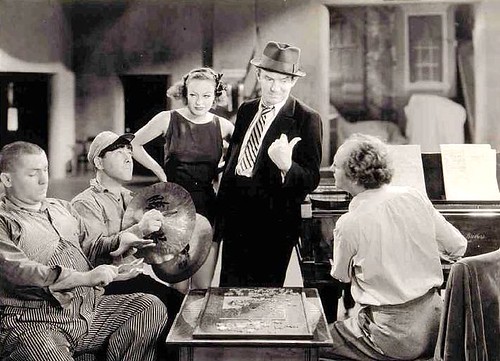
But MGM being MGM, the story centers around the ambitious chorus girl (Joan Crawford) instead of on the hard-driving director as in the WB film. The character in the latter has no time for romance, but Gable and Crawford begin their partnership that lasted through eight other films. MGM substitutes Ted Healy for Warner's Ned Sparks, and since Healy had three stooges, they come along, too. Yes, the Three Stooges in their last "A" production. Larry is rather believable as a rehearsal pianist (he was reportedly a good violinist), and Moe and Curly float through the background of the film almost constantly poking and slapping each other. They all demonstrate a rather natural acting technique, easily overlapping dialogue and moving comfortably in and out of scenes. But they are never permitted to complete a set routine.

Instead, Larry gets to mime the piano accompaniment for Fred Astaire's film debut. Astaire is tossed in casually, without introduction, using his own name, as a sort-of "guest star" appearance, first in a brief rehearsal and then in the final sequence of numbers. Not content with that, we get an early glimpse of Nelson Eddy before operetta--in fact, so pre-operetta that he sings the very jazzy "Rhythm of the Age." Not content with that Robert Benchley is running around the margins playing a completely superfluous drunken newsman. One other strange credit on the movie--it is alleged to be based on a novel by James Warner Bellah, known to most film buffs as the writer of the stories on which the John Ford cavalry trilogy was based. This is like finding out that James Ellroy has been punching up the script on Sex in the City.

While Crawford is always believable as some kind of star, she is scarcely plausible as a talented chorus girl promoted to the lead. Her dancing always looked like a cowboy trying to kill cockroaches; the costume designer astutely puts her in a long gown in the finale that masks the awkward jerky movements of her legs. But while she is the film's raison d'etre, she is also its downfall, because the long, dragged-out telling of her romantic ups and downs with lounge lizard Franchot Tone almost drive the film into a ditch. (A pity, because director Robert Z. Leonard has made the first half of the film is very swift and breezy, especially for an MGM product.)

Luckily, she realizes that she really loves showbiz, not Franchot and rejoins the show THE DAY BEFORE THE OPENING, and all is triumphant. (Notice that getting the show rehearsed in time is never discussed in this film, whereas it is one of the central points of 42nd Street.) Because the essential momentum of a backstage story is toward the successful opening night, not toward the successful romance. In fact a lot of backstage musicals were posited on the impossibility of a normal personal life for performers and artists. But MGM wants us to root for the romance, and given that it's with Clark Gable, that's not so bad.

Meanwhile, Gable has been pushing the writers (Sterling Holloway is one of them) to write something modern and up-to-date, and then we find Fred and Joan in lederhosen singing a song about beer. (I can only imagine they were trying to imitate "I Love Louisa" from Astaire's hit show The Bandwagon, the title of which became my favorite Astaire film, 20 years later.) Why is it that Broadway shows in classic Hollywood films are absolutely incomprehensible? You'd think that with only three or four numbers, there could be some sort of consistency to them.

Slight retraction--the strength of the Berkeley films at Warners is that the numbers do seem as if they come from the same show, stylistically if not in a narrative way. But MGM hasn't learned that lesson, and the songs from the show-within-the-show appear to be the first three or four at the top of the stack in the musical building. The one genuine hit, "Everything I Have Is Yours" is sung at a party, not in the show. (Another historical coincidence: the music for this first film by Fred Astaire is by Burton Lane, who wrote the music for Astaire's final musical, Finian's Rainbow. He also wrote the score for the not-bad Astaire vehicle Royal Wedding.)

The imitation Berkeley numbers are actually pretty good imitation Berkeley, except without the implicit "face in the downtrodden crowd" aspect found in the Warners films. (Another random observation--the sound technicians of the day were capable of voice dubbing--Joan's singing voice is thankfully dubbed. Why then are all the chorus girls allowed to record their own weak, wobbly voices for their close-ups? This sort of thing was going on right through the 1940's. Puzzling.)

Clearly MGM was less focused on making a good, coherent engaging film than it was in keeping its production factory going. To that end, it needed to create a Joan Crawford vehicle, whether or not she was suited to the style and subject matter of the film; it needed to work on developing new personalities such as Nelson Eddy and Robert Benchley, even if the film has no real use for them; it must keep existing talent, like Ted Healy and His Stooges busy, even if they can't really contribute. The result is a barely coherent jumble that distracts for 90 minutes but is utterly unmemorable.

Except for one line. Gable orders his assistant, Ted Healy, to fire his inadequate leading lady. Gable: "Send her back to where she came from." Healy: "Oh boss, they closed that place a long time ago." Same goes for musicals like Dancing Lady.

Wednesday, April 7, 2010

Vengeance is not justice


There is little to say, cinematically speaking, about a thing like Law-Abiding Citizen (2009). Director F. Gary Gray has a good eye and can move things along. That the resultant film is both preposterous and nauseating was, I suppose, built in to the project from the start. You must other buy these things or reject them outright. You can't fix them up by cutting a scene here or there or adding a fact to increase plausibility. Plausibility is not the point. It's all about MAKING a point. In fact, the title character is willing to kill 8 or 12 people, many of them innocent and take his own life to make a point. I think they call people like this terrorists.

What bothers me, and this perhaps comes from my experience as an attorney who was for a time attached to the Public Defender's Office, is that the film turns on the assumption that plea agreements are bad. (The writer doesn't seem to like bail, either. I think he should move to Singapore, myself.) There are flawed plea agreements, but that's because there are flawed criminal cases. And in order to do away with flawed criminal cases, we're going to have to do away with the 4th, 5th and 6th amendments, and I'm not ready for that. Moreover, plea bargains yielding lenient sentences are less of a problem than plea bargains which coerce false confessions--which allow unidentified malefactors to go free.

None of this makes Law Abiding Citizen less of a slam-bang thrill ride. But it's the kind of thrill ride that may make you want to throw up afterwards.

Tuesday, April 6, 2010

That's a big 10-4


At first, Trucker (2008) feels like one of those pre-Production Code movies of the early 30s in which women were strong and tough and independent, far more so than they would be portrayed later in the decade.

Then the film seems to be settling into the territory of "women as part of the desperate underclass" films, such as Frozen River and Wendy and Lucy. Then as Michelle Monaghan's central character was reunited with her long estranged son and displays no ability to relate to him, I thought, "Aha, they are remaking all those grouchy-old-man-with-spunky-kid" movies they used to do with Walter Matthau 30 years ago, only now with attractive young women instead of wrinkly old guys.

But in time, Trucker shows its true colors as one of those film-festival films which packs 24 minutes of incident into a thrill-packed 88 minutes. You know, the kind of movie which, after any dramatic incident, needs to have about 60 seconds of shots of the leading lady sitting and smoking and thinking about what just happened. Too bad, because I was waylaid into seeing this film by the presence of Nathan Fillion, who is always welcome. (Someday some smart producer will cast Nathan Fillion and Bruce Campbell in the same movie, perhaps in the same scenes, and my head will explode with delight.)

I know this is not a very thoughtful or analytic post, but the film simply strikes me as one of those films which benefited from the excess of investment funds available three years ago, but would have benefited more from a more thoughtful, complex and engaging script.

Monday, April 5, 2010

It was another time


I remember 1973, the year High Plains Drifter was released. We knew the government had lied and was still lying about the war. Pretty soon we'd learn that the President lied about Watergate (by August, when this film was released, we had a pretty good idea). Nothing was holding together. It was hard to believe in things.

What a perfect time for the most nihilistic Western I've ever seen. Yes, Leone films take place on wide, desolate spaces that look more like alien planets than the American West. Yes, Westerns had taken a more "realistic" turn, with dirty little towns occupied by amoral hypocrites. But High Plains Drifter takes that bleakness to a new high or low. There is nothing to hold on to. Eastwood's no-name character exploits these townspeople's awe of his shooting skill to embark on a path which will end up with them destroying themselves; no further action by Eastwood is necessary.

On the way, Eastwood rapes two women until they like it--one of the odder notions of the 70s that I am always startled to see actresses give their tacet confirmation to by agreeing to act these scenes. Oh, and he lights dynamite with his cigar and blows up half of the hotel (the baddies just tried to kill him in his room). The film seems to want to blend the mise en scene of Leone with the casual, but somewhat humorless violence of Don Seigel; Eastwood's two directorial mentors.

It moves in that sluggish manner typical of both Eastwood and the 70s, but it pays off in the last 30 minutes or so. Still , if you are going to have a look, have something jolly to pop into the DVD player right after, because Drifter posits no happy future for the human race.

Friday, April 2, 2010

Love and death...fun, right?


I guess there's a romantic comedy to be made based in the grieving process, but Love Happens (2009) is not that movie. Billy Wilder almost succeeded with Avanti! about two middle-aged people going to Italy to pick up the bodies of their parents who had been carrying on an illicit affair. That one is, I suppose, your leading picking-up-a-dead-body romantic comedy.

If only Love Happens had anything that interesting happening. There's slick, and there's so completely lubricated as to have no friction whatsoever. Moreover, from the craft standpoint, at no time does the screenplay fuse its two disparate bits--Aaron Eckhart trying to learn how to mourn the loss of his wife with the tentative romance with Jennifer Aniston. Aniston is such a charismatic actor that evidently writers and directors do not feel it necessary to actually give her a character to play, so her sole personality trait is a penchant for finding big words and writing them in secret places. Seriously, that's it.

It doesn't help that Eckhart's character, a man with a successful self-help book, who cannot take his own advice seems like a pale reflection of the far brighter, quirkier and funnier character played by Jeff Daniels in The Answer Man. Nor does Eckhart's big public confession of what a fake he is strike any note of originality (See the classic Hail The Conquering Hero to see this device used effectively.)

It doesn't help that, whether through happenstance or design, men's griefs are treated as serious and dramatic, while women's griefs are light and funny. I guess it's not as big a deal to lose a man as it is to lose a woman.

Finally, there is a crippling lack of chemistry between the leads, who seem to be capable professionals who can appreciate each other's skill and work together amicably, but strike no sparks of passion. On the DVD, there is a special feature about the digital effects used in the film to make elements filmed separately appears as if they are in the same place and the same time. Unfortunately, the romance which is supposed to be at the heart of this film looks as though it, too were a digital effect.