Showing posts with label satire. Show all posts

Sunday, October 18, 2015

Remote controlled

How would warriors of the past done with their CO riding them all day?
Andrew Niccol (creator of the airless Gattaca) is a bloodless sort of filmmaker, which makes him either the best or the worst person to guide Good Kill (2015), a movie about the toll the drone war puts on the people conducting it.

How to explain? Well, for example, there's that damned Peter Coyote, our modern-day Alexander Scourby, an actor who sounds so inhumanly good he is instantly unbelievable. You know Peter Coyote, he's the guy you that makes you think "I thought Henry Fonda was dead" when you hear his voice-over work.  He was even featured on-camera as the announcer at the Oscars.  As a former counter-cultural figure, he once was an avatar of authentic independence and quirkiness.  Now he is the simulacrum of those American qualities.


In Good Kill the voice of Peter Coyote is employed with implicit satirical intent as the voice of the CIA, telling military personnel who to blow up and when, regardless of the violation of military rules of engagement.  But Coyote does not sound like a Man Who Knows.  His authenticity has been sanded off.  He sounds like what he his, an experienced actor who has recorded his lines very well. Given this is about an artificial remote-control war, perhaps that is the intent.  But the result is that all the scenes in which his character, code-named "Langley" (some code), appears are slack, lacking tension, suspense or really any interest after his first appearance.

You can't critique slickness and artificiality unless you have something to compare it to, and Good Kill lacks any actual human behavior to form a critical baseline.  Ethan Hawke is an impossible Boy Scout.  Bruce Greenwood plays the same gruff and lovable CO that we've seen in the movies since Ward Bond's heyday.  January Jones plays an empty-headed blonde wife.  Zoe Kravitz is a Latina soldier, so she is disciplined, yet spicy.

Doesn't anybody write second drafts anymore?

The idea for this film was so good, that it's a shame that this placeholder film had to be first.  To its credit, it tries to be fair.  It is not an extreme liberal anti-war diatribe.  Even the unreflective aggressive military types are given time and space to be right.  Bruce Greenwood's character points out toward the end that if we walk away from this war, the enemy won't.

But Good Kill is constantly cheating.  [Spoiler Alert]  Defying orders, Ethan Hawke takes aim at a terrorist fighter not on the target list, but whom he has seen raping a virtuous mother.  At the last moment, the woman steps into the kill zone and Hawke believes he has killed rapist and victim at once.  That is a smart story idea about going out on your own without support, without preparing, without a rationale, just operating on emotion, and the terrible toll rash action can have, even if acting for the best reasons.  But then the film does the old Disney switch (they've been doing this since The Jungle Book) and hurray!  the woman is not dead, but just knocked down by the impact of the blast, and Hawke was right all the time.

Well, that (a) settles nothing morally; (b) is super-phony and (c) smug.  A hat trick of bad storytelling.

In similar fashion, Hawke has to agonize for perhaps minutes about losing his airhead civilian wife but attracting the romantic interest of the smart female officer who sits next to him all day.  Introduce problem -- solve it conveniently within minutes.

I'm no fan of Syd Field, but are we going to complete ignore his observations?

Maybe the best thing we can do if we want to contemplate the danger of remote-control war is not to make a new movie, but just take another look at Dr. Strangelove.  [Confession -- when in doubt I always watch Dr. Strangelove.]


Sunday, November 11, 2012

A sharp veer to the left and straight off the cliff


I have just seen two films recently which, in a strange coincidence, both feature John Goodman and Melissa Leo (who played a couple in Treme) in separate storylines for which they share no scenes.  And both films start in one genre, suggest a certain layer of complexity which is never fulfilled, and then make a sharp 90-degree veer in a different direction, one with more success than the other.

Michael Parks and John Goodman talk theology.
The films are Red State (2011) and Flight (2012).  Both had wonderful marketing campaigns that were criminally misleading.  I have no idea why Red State was marketed as a horror film, which automatically put a lid on its earning potential, while at the same time directed it to the wrong audience, which rightly rejected it.  The fact is, that the first half-hour of the film trades on a premise which might also be used in a horror-film:  teenage boys lured by the promise of sex, but delivered to a very different and frightening fate -- some sort of unspecified harm by a bunch of Westboro Church-type evangelicals led by Michael Parks.  Except that that particular velvet glove not only lacked an iron fist, it lacked any content whatsoever.  The threat turned out to be utterly fake, and the film morphed into a satire of the inadequacy of government bureaucracy in the face of utter suicidal lunacy.

To Kevin Smith's credit, he started off with a cardboard political agenda which he is simply too good a writer to adhere to and -- perhaps unconsciously -- realizing that when he got there there was no there there, took off not so much for another target, but in favor of character over ideology.  He wanted to make fun of extremist evangelists, but he seems to have been distracted by the idea of some poor working stiff in the ATF having to sort out a potential Waco-type mess he wants no part of without it blowing up in his and everybody else's face.  It's this sort of thing that leads me to wonder if Kevin Smith ever writes second drafts, or whether -- given that it takes him years to get the energy to crank out a script -- he is satisfied with just getting something down on the page, then immediately dials up his production manager and starts perusing the craft services menu.  (Yes, I know that he raised the financing and distributed the film himself, so the process was a bit more complicated, but...)

Nonetheless, once you get past the tedious set up of the premise of the movie, with a long, redundant monologue by Michael Parks, the film centers around the always-satisfying John Goodman as a man in the middle, squeezed between doing the right thing and toeing the line with his superiors.  This is first-rate satire, but it lacks the time and scope to have enough weight to anchor the entire film.  Then Smith tosses in an anti-climax in which what sounds like The Rapture turns out to be some hippies teasing the evangelicals.  I say "tossed in" because what could have been an intriguing and funny scene is conveyed by some dialogue in a brief denouement scene.  (Plus Smith admitted it was added after the fact in his video Q&A, Kevin Smith: Burn in Hell.)  The result feels like an anthology of different films from different genres stitched together sequentially.  I don't know how Red State performed commercially, but I can't help but think that there must have been a LOT of disappointed horror fans.

Denzel got some explainin' to do.
When John Goodman appeared on screen in Flight (2012) a lot of the audience, including me, "ooh"-ed with the feeling of "Oh boy, this is going to be good."  We were also to be disappointed.  After a slam-bang initial half-hour of Washington performing an heroic landing of a wounded passenger plane while drunk and high, one looks forward to the story of transcendence and transfiguration promised by (a) the title of the film; (b) the spiritually suggestive trailers and television ads; and (c) Zemicki's work in Cast AwayForrest Gump and the failed by aspirational Contact.  No such luck.  John Goodman's role as Denzel's connection turns out to be dispiriting rather than energizing, and the rest of the film is a rehash of The Lost Weekend, Days of Wine and Roses, Clean and Sober, 28 Days and every other movie about a drunk trying and failing to clean up.  These stories are always repetitive -- they have to be if they're going to be realistic, but that doesn't make them any more fresh or insightful.  This is a movie without anything to recommend it other than Denzel's presence, albeit he doesn't have anything else to do.  And a movie that can waste Don Cheadle, John Goodman, Melissa Leo and a lot of less-famous but equally ill-used actors rates as a major waste of time for the audience and the filmmakers.

It would seem that would have been fairly easy to make a much better, much more original film.  And how disappointing that Denzel finally breaks away from the tedious potboilers he has given so much of his working life to (Safe House, Unstoppable, Taking of Pelham 1 2 3, Inside Man), the result is still deja vu, just in a more exalted genre.

Sunday, October 28, 2012

Found in America

Aladeen explains the fine points of the Bill of Rights to a NYC policeman
You knew as you were watching Sasha Baron Cohen's film Borat that, like Daffy Duck blowing himself up, it was a one-time only performance.  The film's very popularity would make it impossible for Cohen to slip invisibly into another identity with which to trap and trick people.

It turned out to both true and not, as people have short memories and Cohen has a very adaptable face.  Still he is never going to take America by surprise quite the same way again.  So he can hardly be faulted for taking the scripted route to pursue many of Borat's themes and tropes again in The Dictator (2012)   He can be faulted for adopting the hoary old substitute-the-double-for-the-king plot that goes back at least to The Prisoner of Zenda and never seems to stop being reworked.  You'd think monarchies would have the good sense by now to seek out all the perfect doubles that seem to riddle the earth and have them done away with to avoid problems.

Three other observations.  The female lead played by Anna Faris claims to have attended Amherst College.  This is impossible because (a) she is wearing the Mt. Holyoke College uniform (basically grunge drag) and (b) she pronounces the name of her school "Am-hhurst."  Even those who attend U Mass are aware that the "h" is not pronounced.

Second, what is there about comedies about dictators which calls for a speech late in the third act?  Chaplin's Great Dictator speech is (rightly) criticized for being overlong and unfocused.  Cohen avoids such problems and goes straight for the jugular.  Yet, though this is the sharpest humor in the film, it seems to go unnoticed amid the slapstick and buffoonery.


By definition the film can't be as outrageous as Borat but it almost makes up for it by incorporating a large cohort of sketch and stand-up comics, probably the contribution of director Larry Charles, who is more likely to be plugged into American comedy circles.  Aasif Mandavi, Rizwan Manji, Horatio Sanz, Chris Parnell, Jessica St. Clair, Chris Gethard, Fred Armisen, Chris Elliot, Jon Glaser, Bobby Lee, Joey Slotnick, J.B. Smoove, Kathryn Hahn, Seth Morris, Nasim Pedrad, Ed Norton, B.J. Novak, Jim Piddock, John C. Reilly and Gary Shandling all have walk-ins and sometimes quite a bit more in this film.

It really suggests that what Cohen and Charles should be reworking instead of Zenda is an all-star comedy extravaganza along the lines of It's a Mad, Mad, Mad, Mad World.

Thursday, May 17, 2012

Idiot savant or idiot idiot?

This is not a special effect.
Johnny English Reborn (2011) is a perfectly agreeable, if anachronistic slapstick Bond parody.  Given that it is now in home video, if you choose to watch it, it will be merely a matter of adding it to your Netflix queue or dropping a buck at Redbox, and not $28 at the nearby MegaPlex 3000, there is no reason for you not to do so, unless you don't care for laughter or entertainment.

But it IS anachronistic.  How can we keep kidding Bond movies 40 years after the fact?  They are not only no more or less funny than they always were, but Mike Myers has clubbed that particular dead horse beyond recognition, with diminishing returns.  (Yes, I know the leaping-off place is Michael Caine's Harry Palmer character, but believe me, the Myers films are kidding Bond not Palmer.)  And that's not to mention Inspector Clouseau, Maxwell Smart or the hero of the OSS 117 films played by Jean Dujardain.  (We will not discuss Jack E. Leonard as The Fat Spy.)  The woods are full of inept spies.

So decisions must be made.  Clouseau is a supremely confident idiot who sales through adversity, triumphing by bizarre accident.  In the meantime, his ineptitude causes social embarassment for himself and physical harm to others, but rarely harm to himself.  He never becomes self-aware, and none of his gambits work the way he plans for them.  Same for Maxwell Smart, who alternates confidence and sheepish humility for Clouseau's oblivious arrogance.  Dujardin is physically capable--he can even intentionally kill, but he has wandered in from another era, and it is his sexism, racism and thick-witted intransigience that makes the OSS films funny.  The Austin Powers are more cultural send-ups.  Powers is also sexist, but the character's childlike enthusiasm excuses his worst behavior.  But Powers is not inept, just a bit culturally clueless and capable of catching up fast.

But Rowan Atkinson, perhaps the greatest combination of comic gifts -- body, face, voice and writing -- combined in a single person of any person alive, can not get Johnny English to settle on a single joke.  Bring him into a room with dangerous and/or breakable things, and they will go zooming and crashing around, causing financial and physical mayhem.  But minutes later, he can outwit and outfight an opponent using sly and clever tricks and even execute Bond-style witticisms--not vulgar burlesques of them, but actual wisecracks a la mode.  Sometimes he understands the mission, sometimes he doesn't and there is no way of predicting it.

Buster Keaton flirted with this problem. His character was frequently referred to by others as a dimwit or a dunderhead, but he had this fabulous intuitive understanding of the natural universe. Perhaps the movie Buster (not the real man) was the first Asperger's comedian, brilliant within his area of expertise, but lacking the ability to read other human beings, or master their strange social customs.  Somehow he made it all hang together.


Jerry Lewis does not and does not seem to be aware there is a problem.  His basic character has been described as a parody of a juvenile idiot.  But if it is necessary to become brilliant to pull off a momentary gag, Lewis will do it, because nothing is important to him as the gag of the moment, and if it distorts the character or the story, Lewis doesn't care.  His movies have Attention Deficit Disorder, which in turn, weakens the gags, since they are rooted in nothing.  For those of you, who get the reference, Jerry Lewis was the Larry Semon of the 1960s.

Atkinson has no such problem with Mr. Bean.  Mr. Bean is inexplicable, but consistent.  He is a child, but, like Harpo Marx, a child who has been around a little bit and seen some things.  But Johnny English, funny as it is, is always in danger of turning into Thirty-One Gags In Search Of A Movie.
One incidental note -- when did the English decide Gillian Anderson was English?  She's from Chicago, and her English accet is only passable, especially in comparison with a Gwyneth Paltrow or a Jennifer Ehle.  But she's done two Dickens mini-series and now this picture.  There have to be some working actresses in Great Britain between 35 and 55, surely.  Anderson isn't convincing to me as a Yank--what could she sound like to a Brit? 

Sunday, May 8, 2011

Craziest damn movie.


Most of the time a new medium arrives, it does not utterly supplant a predecessor medium, but the roles and functions of the media often get rearranged. Since the arrival of the internet, television--including cable--has completely dispensed with distributing news and facts and has turned all of human existence into a tasteless zoo. When television arrived, radio stopped dealing with narrative, but took over music and breaking news completely, leaving records for collectors and newspapers for obsessives. Television also took over what remained of vaudeville and the variety stage, and those two forms have completely disappeared other than in the completely vestigial form of comedy sketch shows with music acts tossed in to fill time. (Incidentally, those music acts are not there to draw audiences -- music has a much smaller audience than the relatively small audience for hardcore comedy.)

But for awhile, radio proudly carried the banner of vaudeville and variety, albeit with some technological limitations. Although there was a concerted effort to make radio stars into film stars, the only ones who succeeded were Bing Crosby and Bob Hope. Jack Benny, the #1 star in radio, had a film career that literally became a joke, at least on Benny's program, and his pretend rival-and-nemesis, Fred Allen, only made a handful of films. But in one case the resulting film did a good job of projecting the trademark Allen mixture of cynicism and insanity. Fred Allen was sort of the David Letterman of his era, a decent and sensible guy who could be made cranky when contemplating the news, celebrities and the machinations of the entertainment business. Best remembered as the man who said that television is called a medium because nothing in it is well done, he once had a character conducting a tour through 30 Rock say, "That man with the moss on him is an NBC vice-president."

It's In The Bag (1945) was made independently, is based on the same story as Mel Brooks' The Twelve Chairs and boasts one of the most insane cast lists of all time. New Yorker humorist Robert Benchley plays a exterminator, Jerry Colonna plays a psychiatrist, horror star John Carradine plays an evil lawyer in top hat, morning coat, striped pants and pince-nez, William Bendix plays a deadly gangster called Bill Bendix, Jack Benny plays himself and at one point the down-and-out Fred Allen joins a quartet of singing waiters comprised of Don Ameche, a fading film star of the 30s, Rudy Vallee, a fading radio star of the late 20s and Victor Moore a faded stage star whose career began at the dawn of the 20th century. This would be akin to a movie in which a washed-up Conan joins a rock band comprised of Steven Tyler, Englebert Humperdinck and Robert Wagner.

This is the kind of movie in which Fred and his wife (played by Binnie Barnes, whom people like me may remember from Abbott & Costello's The Time of their Lives) are told by Jerry Colonna that they need to kill some time, so they should go to a movie. They are told that there is immediate seating for the feature Zombie in the Attic (is this a Val Lewton RKO or a Universal horror picture -- I wonder?). There is in fact no seating, which they learn after taking an elevator to the top balcony which appears to be 16 stories about the screen and squabble and joke with a half-dozen managers about the price of movies and crowding in theaters. Finally, when Fred demand a seat, the manager reaches into his closet and hands Fred one of the five chairs he is looking for according to the scrap of an anecdote that serves as a plot, which you had forgotten about for the last ten minutes.

What I'm trying to say is that this is not any kind of a movie. It is a very funny thing, but it lacks most of the rudiments we expect from cinema, such as story, character, setting or connection to the known universe. It is a craziness like International House, Hellzapoppin' and Never Give A Sucker An Even Break. Given the technological and distribution facts of the day, the craziness had to be shot on film and shown in movie houses, but that doesn't make it a movie. But cinema or not, I wish they still made things like this today. (I can just hear the development executives saying, "but you have to make your hero sympathetic." Fooey.)

Here's the opening of It's In The Bag, startling for 1945, which trades on the old joke of the host telling the radio or TV audience, "We've got a great show for you tonight." We all know that's a lie. The thing is on every week, or sometimes every day. There's no way it could be "great" again tonight, and even if it were "great," how would the host know in advance? It's a crap shoot, let's accept it, and the odds are against. Personally, I never get tired of the "this show is crap" joke, as practiced today on NPR's Car Talk and on Craig Ferguson's show. This version has Fred Allen deconstructing the credit sequence in an extremely post-modern way:

Wednesday, October 13, 2010

Wes Craven is an amateur in comparison


The Jone$es (2009) is the best suburban horror film since Dawn of the Dead -- either version, it doesn't matter -- it's just the central metaphor comparing consumerism to living after death and eating brains.

The characters in this film are living a non-life; so thoroughly that I found it difficult to contemplate living that life for even a few moments. It's one thing to be an actor and within a pre-determined environment under a special set of circumstances, tell a story by assuming a character other than one's own, for a period of between three seconds and three hours. But to have every waking moment engaged in a fiction--that is the definition of loneliness.

I am interested in cons and con men and have read a great deal of the fairly minimal literature on the subject and what strikes one--after you get past the imagined fun of seeing the dishonest get their comeuppance due to their own greed--is how lonely the life is. Con artists don't have friends--can't have friends, and can't really have a family, at least not the way normal human beings have. That is the fascination of both The Grifters and Matchstick Men (probably the two best con movies after The Sting), in which concepts of family get distorted and tortured into strange shapes due to this strangest of occupations.

So The Joneses are not real people engaged in any real activities--I am not posting any spoilers to say that these people are living product placements. They exist merely to interest the neighbors in the various things that they are consuming. The details of this conceit are completely nonsensical--there would be no way to measure cause and effect here, we are dealing in a satiric fantasy, and as an old boat builder said, pointing at a seam in the fiberglass said, "that's where they put it together and that's where it will fall apart."

OK, pretend you're a screenwriter now, and imagine you have two actors-slash-con artists pretending to be a sexy, happily married couple. What do you suppose will happen? Of course. you don't have to see the movie to know that there will be romantic and sexual confusion here. So that's one thread. Then-- your characters are advocating relentless consumerism, and to make the engine of your story go well, you have to put the perfect victims in the house next door (well played by Glenne Headley and Gary Cole, pictured above, both actors who can vacillate between likability and desperation). Weak, insecure people desperate for approval and respect, without a firm value system of their own. Great-- Moliere himself could go to town with a set-up like this.

Now--these poor marks have spent far beyond their means putting them in danger of losing their abode and being thrown out of Paradise itself. (This probably was funnier when it was written in 2005 or 2006 and we were more worried about excessive credit card debt, not a housing and banking meltdown that brought the entire economy to its knees. Additional support for my hypothesis that this had a long development curve is that 12 people have some sort of producer credit, suggesting a project which passed through many hands before receiving a green light.) What will you do with the comic situation of foolish people at the brink of ruin through their own foolishness, but egged on by your protagonists.

The Joneses chooses this moment to abandon the satiric never-never land it has lived in and jump into a facsimile of the real world, introducing real tragedy and real remorse. I'm not saying this shouldn't be done or that it is impossible. I'm guessing that a Billy Wilder, a Stanley Kubrick, a Paddy Chayefsky, a Robert Altman (especially), perhaps even an Aaron Sorkin could do it (to name the most prominent film satirists that come to mind rapidly). But writer-director David Borte does not have those skills, notwithstanding those of the under-appreciated David Duchovny, one of the most slyly funny actors on the planet.

Worst of all, the shift in tone overemphasizes the fragility of the initial premise, and leads us to think of all the reasons that this could never happen and the scheme could never work, chief among them the fact that human beings are involved.

The other principal missed opportunity, it seems to me, is in the cinematography. Not to direct over Mr. Borte's shoulder, but shouldn't the look of the film ape its central premise? Shouldn't the film look like a super over-produced shiny commercial when the Joneses are touting all their wonderful toys to their "friends" and "neighbors," a look which could be contrasted with the look of the backstage scenes? The film was a low-budget affair, probably shot quickly to accommodate the cast's busy schedules, but with some planning, the production, especially light and sound, could have been engaged to enhance the concept.

Swing and a miss, but a miss not without merit.

Thursday, August 19, 2010

Emergency! Everybody to get from stritt!


As it is August, and I would rather be in Maine, I pulled out an old friend, the movie The Russians Are Coming The Russians Are Coming (1966) which reminds me of New England and of the summer in Maine when I first saw it. (I was surprised to learn it was shot in Sausalito, so accurate are the rickety little New England houses and stores built for the movie.) I loved the movie then and my inner 10-year-old still loves it, perhaps because the children are the only ones who behave sensibly while the adults run around like idiots. The art is in the varieties of hysteria exhibited by the denizens of a small New England island (based on Martha's Vineyard in the 50s) when they believe Russians have launched an attack.

My first reaction in re-watching it, is to wonder why Jewison didn't cast a stronger leading man as the writer played by Carl Reiner. Reiner was never successful as a star (his sitcom Head of the Family didn't work when he starred in it, only when it was recast with Dick Van Dyke). Dick Van Dyke would have been a logical choice--he was making a lousy picture for Walt Disney at the time that could have been postponed. Jack Lemmon would have been good, too.

But then I realized Reiner was the perfect choice, because he is actually second banana. The story is really about the submarine officer leading the landing party, and again director Norman Jewison exhibits his casting genius by bringing Alan Arkin to the screen for the first time, in the fully justified confidence that Arkin would more than carry the film--he would triumph. In this case, the movie is inconceivable with anyone but Arkin. I can't think of another comic actor of his generation who seeks so little approval from the audience, or even awareness of them. Like Chaplin, Keaton and Lloyd, he is fully absorbed in the task in which he is engaged and has no time for "business" or "takes." He just exists, unaware of and undistracted by the absurdities piling up around him. Yet, somehow, he is likeable, if only because of his earnestness and the way his essential competence has been tripped up by circumstance.

The film has the usual flaws of a film based on a script by William Rose: it is too long and redundant, with many scenes devolving into mere squabbling, without real comic bite or crispness. Rose has an interesting career, with a lot of almost-great work. He was an American living in England, and had his first hit with Genevieve, a sort of low-rent version of The Great Race, which exhibits his trademark over-talkativeness. Then came the brilliant Ladykillers (the original British version, puh-lease) and the charming Smallest Show On Earth, which should be better known to film-lovers, because it is about them. Then he seems to have run afoul of American producers, and the drift began. He wrote Scent of Mystery, a gimmick film in which clues were rendered as "Smell-O-Vision." Then came the grotesquely swollen It's A Mad, Mad, Mad, Mad World, a brilliant idea buried in mountains of dull dialogue. (I was going to call it pedestrian, but that would be unsuitable for a road movie.) Then Russians, The Flim-Flam Man, a not-bad con movie with George C. Scott and Guess Who's Coming for Dinner, for good or ill, and again with the redundant dialogue. What Rose could have done with a good editor or co-writer!

Back to Russians: I have seen criticism of this movie on a political basis; that it establishes a moral equivalency between the US and the Soviet Union. This is the kind of irony that's hard to pull off. To judge this film that way is to make exactly the same mistake made by the hysterical ninnies in the movie. This movie is not about dreaded Soviet invaders. (Why is it that today's conservatives can't remember that Ronald Reagan's dream was not to defeat the Soviets, but to negotiate disarmament with them?) The movie is about a poor cluck who has an idiot for a boss, and idiot who made a problem (running the sub aground) which he now has to fix. Clearly, they have no interest in ideology or conquest. Arkin and his crewmates are just trying to keep their heads down and get their jobs done--just like anyone else in this predicament. Soviet Communism was not like a terrorist cell, or some other tiny group of fanatics. It was a huge bureaucracy, and the process of surviving under one of those is universal and essentially apolitical.

And it is good to see Norman Jewison unafraid of letting broad actors do their broad stuff. Paul Ford, Tessie O'Shea, Ben Blue (forever chasing his horse "Beatrice"), Jonathan Winters, Michael J. Pollard--this is one of the biggest servings of ham ever put on film. Today, directors mostly have two modes: (a) fear of actors, so they are never given an opportunity to do what they can, because their performance has been cut into tiny shards of film, and composited like a Byzantine mosaic; or (b) over-solicitousness of actors, so that the camera zooms in on each quivering eyelid and pulsing cheek muscle in long-long takes of nothingness. Jewison and his actors were old enough to remember the last stages of vaudeville (Jewison started in television variety programming) and knew that actors like these need space and time to do what they can do. Then Jewison places Brian Keith as the quiet, still center of the movie which heightens all the lunacy around him.

Incidentally, this is one of the few films or plays (The Importance of Being Earnest is the most important example) that observes the Rob Lockhart Terminal Title Drop Rule (by which rule, once the title is stated, the film, play, novel, what-have-you Must End Immediately). In the case of Russians, it's hilarious.

And--I can testify from seeing the film with audiences over the years--the movie still stimulates laughter. Laughter--how can I explain what that was...See, in the old days, in comedies, instead of people merely performing bodily functions or saying the baby words for them (which excites hysterical laughter in 2-year-olds of all ages), they actually did things that were funny and made you laugh, which Wikipedia says is "an audible expression or the appearance of happiness or an inward feeling of joy (laughing on the inside)."

Oh yeah, joy.

Sunday, May 9, 2010

Stop reading this blog right now!


Open another window or tab and add The Deal (2008) starring (and co-written by) William H. Macy to your Netflix queue right now! I mean it! I'll wait here. Hmmm...ladedadedudumdum
...lalalala...Oh, good, you're back.

This is the funniest, most exhilarating, cynical yet hopeful low-comedy satirical romances I've seen in a long time. Even though the film debuted at Sundance to enthusiastic audiences, the producers were unable to get theatrical distribution that made economic sense. [Meanwhile a wretched thing called Chloe just hung around my neighborhood theater for a month attracting flies.] All of this is a long way of saying that although the film was a direct-to-DVD release, it's a first-rate film.

Based on, and fairly closely following an insider-written novel about Hollywood, the story offers the lesson that the best way to succeed is to stop caring. (In this way, it echoes the immortal Office Space.) Failure coupled with momentum is the true path to success.

As I've said here, I'm not trying to run a review site, so I won't recite the story or the excellent comedy cast (except to mention that it is night to see a woman of Meg Ryan showing that she, like Diane Lane, can play her own age and still be very sexy). I find myself hard put to discuss the cinematic style--in this type of fast-moving acerbic comedy, in the school of Preston Sturges and Billy Wilder, the craftsmanship is simple and unobtrusive. These films are all script and performance, both of which are top-notch.

The only other thing I can think to say is that this the only film ever to accurately demonstrate exactly what a producer does. Most movie producers in films are uncultured morons, cutting budgets, hiring relatives, spouting moviebabble that they don't understand. Macy's sharp producer has learned from the school of William Goldman that Nobody Knows Anything and from Woodward and Bernstein to Follow The Money. Keep your head down, cash the checks and keep moving.

Seriously--if you really like movies, see this one.

Thursday, May 6, 2010

Ice cold and dipped in acid


I was glad to have the occasion to revisit one of the films that honed my taste for bleak and cynical satire when it came out during my high school years, Cold Turkey (1971). Thanks the DVD-on-demand program by Fox Video as distributor of MGM/UA library, the film, written and directed by Norman Lear on the eve of creating All In The Family, is available from Amazon, from an unrestored but watchable print.

Let's start from the top. Any movie that begins with a mangy old dog wandering into a dying rustbelt town to the sound of Randy Newman singing "He Gives Us All His Love" (which Newman apparently wrote expressly for this film) is already doing well. The premise is simple, albeit full of holes: a town which can give up smoking for 30 days will get $25 million from a big tobacco company. Don't think too much about that--it won't hold up. The film isn't about smoking, it's about greed and ambition.

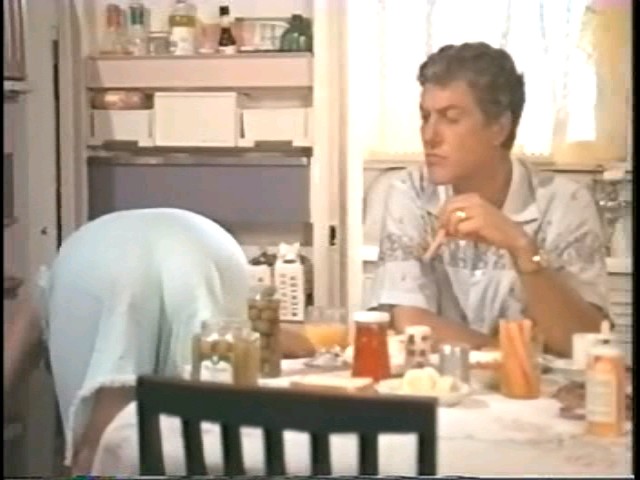
The most ambitious is a sanctimonious hypocritical Methodist minister, played by the usually loveable Dick Van Dyke, who is looking for a way to get out of this armpit of a town. He bullies his wife and smarms his way around town. All the expected complications develop, aided and abetted by such skillful comic actors as Vincent Gardenia, Jean Stapleton, Barnard Hughes, Tom Poston, Graham Jarvis, Barbara Cason, Bob Newhart, Edward Everett Horton and, in their only feature film, playing all the newsmen in America, Bob and Ray. And, again, how can you disparage a movie in which one citizen expresses her frustration over not being able to smoke by kicking a dog clear across the town square. I mean, dog-kicking is one of the biggest no-nos in the history of the movies!

Also, you gotta like a movie in which Richard Nixon hops on the bandwagon at the last minute for no good reason except self-promotion. (I'm said to say he's portrayed in long shots by a guy in a rubber mask, but any excuse to dump on Nixon will be gratefully accepted.) And that was filmed in 1969 (the film sat on the distributor's shelf for two years) before we knew exactly how big an SOB Nixon was.

Like It's A Mad Mad Mad Mad World, there is only one good and decent person in this universe, and her voice is drowned out in the madness. The finale may not make any sense--after 30 years I'm still hard pressed to say what it means--but it's sheer nihilism gives a tingle of spiteful pleasure.

I mean how can you beat three hypocritical cynical gasbags being shot accidentally by a crackpot old lady wingnut, while an hysterical crowd cheers for Richard Nixon and ignores the dying men right next to them? Awesome.

Monday, April 12, 2010

An American life with no second act


I used to travel to France on business and I did not find the people slow or obtuse or having difficulty picking up on things. So why can French films be so slow? Cold Souls (2009), written and directed by French-born Sophie Barthes, has a pretty good joke to tell, but it tells it--slowly--then tells it again, then sort of loses interest in going on, flops around listlessly and stops.

Yes, the movie has ideas, or at least one, but it treats that idea like a shopper in a gift store, picks it up turns it around halfway, then puts it down and goes on shopping. At no time is the idea explored, developed, worked out, or even reversed. It's simply stated and we are all expected to sit back and congratulate a movie for having an idea.

The idea is that the soul is an extractable item, that it brings unbearable weight to some people, and that some people are happier without them. Yes, I know they should have brought Donald Trump and Paris Hilton on at this point, but no, they go to Russia, where everyone has "heavier" souls than Americans. This idea is presented without a speck of irony, as is the concept that Russians are either downtrodden plebes or gangsters.

Paul Giamatti plays an actor named Paul Giamatti, but strains credulity that an actor of that intelligence would imagine he could continue in his chosen field without a soul (unless of course he had a series on the WB). The self-referential aspect invites comparison with Charlie Kaufman's work, in which both John Malkovich and Nicholas Cage have played characters who have the same name and occupation as they do, inviting the audience to believe they are playing themselves. But Kaufman keeps pulling rabbits out of the hat, but this movie quickly becomes all hat and no rabbit.

A few examples: After Giamatti has his soul extracted, he has a terrible rehearsal playing Chekhov's Uncle Vanya as a manic narcissist, turning the role and the play into utter nonsense. Director Michael Tucker simply walks away in disgust, eschewing a chance to explore what's gone wrong. Giamatti immediately realizes the problem and begins trying to solve it (at first by renting another's soul). But what if Giamatti's career had taken off once his soul was extracted. At the moment he's a bit of a cult favorite. When he appears in a pop movie it is in a supporting role, perhaps as a villain. What if having no soul automatically makes you a star? Or what if he had to attend a family reunion with no soul? Would anyone notice? What would they see? The whole concept of being soulless is raised and then immediately dropped so that the film can go on a long tedious trip to Russia.

Why tedious? Because the pretty and marginally talented Russian actress who has had Giamatti's soul installed (under the impression that it is Al Pacino's--Al Pacino would never be so foolish as to have his soul extracted) does not seem to display any effect of having a different soul. Not that she fails at the task--the writer-director simply hasn't provided any opportunity to explore this idea. The whole thing makes no sense, because if her husband (who runs the black-market soul factory) can lie to her about the soul she is given, why bother using any American actor. Why not just grab the first unclaimed soul lying around, which would have saved a lot of money and effort. And we can't see that it makes any difference in the woman's behavior.

This goes to one of my complaints about films with strong abstract concepts--so many of them get caught up with the mechanics of their premise. So a great deal of the running time of the film is spent with soul-extracting machines and the containers the soul comes in and how the "mules" move in and out of the country, that the central concept of the film remains unexamined, and the characters have to spend immense amounts of time finding out information that we, the audience, already know.

Similarly, when Giamatti begins carrying around a Russian poetess' soul, a soul described as "beautiful," why doesn't Giamatti act on the promptings of that soul? Why doesn't he gain greater vision and insight of the world around him? Being sensitive to other souls doesn't seem to have any effect on Giamatti other than burdening him. The unaddressed question for the whole film is "What is the effect of the soul on human life? How does it make us different--from each other and from other types of life? If we are better off with souls than without, why?" At the end of the film, the young woman who has been acting as a "mule", carrying souls back and forth is left with an enormous residue from the souls she has carried. Wouldn't that give her real insight and vision? I don't know. She goes down to walk on the beach. Is that profound? I don't know.

Early in the film I remarked to my wife that this seems like an idea for a Gogol story. But as the film moved along, it remained nothing more than an idea. Doesn't anybody read these scripts before they start shooting? Didn't anyone notice that after the first act, the movie quit? Can't help wishing that a film with this premise had been made by Ricky Gervais...

Monday, March 8, 2010

First as tragedy, then as farce


Admittedly, it's an impossible question for a person like me who views, on average about 200 movies per year, but people (students especially) ask nonetheless, "What's your favorite movie?"

The questioner should understand that she is not asking, "What do you think is the best movie--worthiest movie--most artful movie..." Presumably the question invites discussion of a guilty pleasure. And the fact is, I cling to my bosom a lot of movies that are not very good as movies. The W.C. Fields vehicle It's A Gift is virtually a working manual of crudeness of technique. The Producers barely makes any sense and the last ten minutes or so of the film completely collapse. There's scarcely a musical made that really holds up under serious scrutiny, so they're all out, as are Jackie Chan films.

So perhaps my choice is a bit weasel-y, because it is an Official Recognized Classic. But once one considers the complete and utter destruction of human life due to male pride and vanity, what other response is possible, but laughter? So Dr. Strangelove is, theoretically, that most perfect of comedies--one that makes you laugh to (and at) death.

Any sane person laughs at that movie, then goes home, or upstairs to bed and has the night terrors (my personal definition of a perfect comedy). For that reason, although there has been much scathing satire in the ensuing 46 years since Strangelove's release, few have attempted that kind of large-scale gallows humor.

Thus, In The Loop (2009) sneaks in the side door of catastrophic satire. Presidents, Prime Ministers and Premiers are banned from the landscape, and our gaze is not permitted to go any higher than the sight of cabinet officers, their minions and enforcers. (In fact, the film suggests that critical policy is set without the knowledge or consent of elected officials.) The story, in a nutshell, is that of Britain being dragged into an American incursion in the Middle East primarily due to the thoughtless words of a thoughtless Cabinet Minister.

The film employs the faux-documentary modus best known here from The Office. The value of the technique is to convey the idea that one is hearing things one is Not Supposed To Hear. Interestingly, Strangelove uses some of the same techniques--the attack on the quarantined air base is shot with hand held grainy footage that must have looked very rough in its time. The War Room appears to have been shot with available light (obviously, the light is actually designed, most probably by the DP, Gilbert Taylor, but it appears to make no concessions to the movie camera, as it is alternately flat and harsh. It all lends an air of reality to some rather baroque performances and dialogue. (Although Peter Sellers's rendition of President Muffley's phone call to Premier Kissoff is a model of precisely observed acting.)

In The Loop even echoes Strangelove's immortal line, "There is no fighting in the war room" with a tense negotiation taking place in the meditation room at the UN. This setting is evidently based on fact as told to the writers of the film. According to the director, at the end of a screening of In The Loop to a group of Washington insiders, one of them raised his hand and said, "Can we just say we're sorry?"

Watch it and laugh--if you can handle the truth.