A number of commentators on The Green Zone, directed by Paul Greengrass are still complaining about the immersive camera technique Greengrass favors. Come on, folks, you've had at least since 2002 when Bloody Sunday, Greengrass's brilliant film on the 1972 incident in which British troops fired on and killed unarmed protesters in Northern Ireland. If you haven't seen this superb film, rent or borrow it NOW! Put it in your queue now. Open up another tab on your browser and go to Netflix NOW! I'll wait.
OK, back again. Greengrass has an unusually coherent body of work in film which is bound together by unity of subject matter and style. In fact, the two may be indissolubly linked.
Greengrass makes movies about people who are seeking the truth. Not big, universal, philosophical truth; just trying to find out what happened. And today, with the welter of media outlets mostly controlled by a few outlets, governments managing information and news items categorized not by significance, but by "buzz," finding out what happened is about the most difficult think one can do. It's not comfortable, it's not simple, and the information doesn't arrive in a nice linear order or an elegant three-act structure.
In this context, Greengrass's camera style, being in the thick of it, not moving smoothly from master to medium to close, not framing things perfectly, with foreground obstructions and uneven lighting, makes perfect sense; the truth is got at incrementally, the bits one can piece together which the world conspires to obscure.
Incidentally, contrary to those contemporary films with over-edited fight and chase scenes in which the viewer cannot orient himself and therefore feels alienated from the action, in a Greengrass film I always now where I am, where the other characters are, where the danger is coming from. (A side benefit from a one-camera-on-the-shoulder approach is that it is rare to find a cut across the axis, because the director has not made those kinds of shots.)
Frankly, I am getting sick of the critics my age or older who say "It's cut too fast," or "The camera shakes" or "It's so meta- [or so subjective] that I can't identify what the objective reality is." Who guaranteed anyone that a film would present a view of objective reality, or that editing rules of classical Hollywood would go on forever and ever. How is that different from complaining, "That music today is just noise." Either retreat into the past or go away--life is change, and to stay alive, you are obligated to keep up with that process.
Anyway, back to Green Zone. Damon plays a military professional who gradually realizes that his stated mission is nonsensical and that it is based on either bad or deliberately false intelligence. This is evidently a source of political controversy. I admit room for debate as to the wisdom of the invasion of Iraq (but only because I want to err on the side of reasonableness), but is there a serious argument that planning and early execution of the invasion was amateurish, based on unfounded beliefs and wishes? This is not a matter of left or right--Damon's character's question is simply: "What is it I'm supposed to be doing? And if it's looking for imaginary things, that's an insult to my professionalism and a detriment to the safety of my men."
Thus Greengrass's camera style, which some find confusion and disorienting (I don't) is not a stylistic flourish but a statement of the central theme of the film, if not of the entire body of Greengrass's work: that truth is not-obvious, seldom if ever grasped in toto and ever-changing.
The counter-argument, that truth is always simple and obvious, is a natural point of view for those who are simple and obvious.
The Australian western The Proposition (2005) forever settles the question, "What if you tried to make a Sergio Leone movie without any sense of humor?" This is a movie about bleak--bleak story, bleak characters, bleak landscape; without an ounce of release for the audience. There is good and interesting music in The Proposition, but nothing like the witty eye-wink scores of Morricone, which seemed to say, "Ingrid, it's only a mo-o-o-o-vie."
And whereas the Western often turns on the establishment or restoration of order, here the order is corrupt and evil. So there is no safe resting place, no comfort for the audience. This film is like the guest that came along with your friend who starts yakking in his grating voice and just...won't...stop. Also, I'm sorry about how the white Australians treated the aboriginal people, but they haven't got a thing on how both the English and white Americans treated native peoples they encountered--the latter seemed to me to be far, far worse.
In looking for something else to say about this baked-out, washed-out, shoot-em-in-the-head fest (without the whoop-up fun of a real shoot-em-up), I came across this quote: "...What The Proposition's characters have in common—the only thing they have in common, really—is the desire for community..." I have no idea what this yobbo is talking about. The only thing that happens is that some people get raped, then some people get shot, then some people get beaten, then more people get shot, then John Hurt natters on about something for 6 or 7 months, then the world's biggest psycho says it's all about family, and then his brother kills him, and do I really need to go on. This isn't a revival of the western genre, it's a concerted effort to destroy it forever.
For most of the history of dramatic storytelling, originality of the plot was not considered a primary virtue. The ancient Athenians expected to know the story of the play they were going to see in advance--in fact, most of them were traditional stories they had known from childhood, or perhaps soon after. The playwright's art was the expression of that story and the character's reaction the events through verse and dance. Making up a new story would have completely confused your average Athenian, sort of like those two old ladies who always sit behind you at the movies and try to figure out the story out loud while you're trying to hear the dialogue.
Shakespeare, as we all know, swiped his stories from legends, from from Hollinshed's Chronicles from Plutarch's Lives and Italian and other story collections. Nobody faulted him for that in his own era. It is only since short story writers such as O'Henry and Maugham popularized the twist ending that it became bad form to give away the story, culminating in the great story conspiracy of Hitchcock's Psycho.
So the idea of a remake is not inherently dishonorable, at least in historical perspective. So why retell an already told story?
1. We know everybody likes it. The trouble with this in the home video era, is that we can always go back to the source. Back in the day, when MGM remade Little Women in 1949, they knew that not many people would have a good memory of the 1933 RKO version, but just to make sure, they bought the earlier film and suppressed it. But nowadays, if we're jonesing to see Wuthering Heights, we have the choice of about eight different versions, including a number of television adaptations. But none of them have the heat of the Olivier-Oberon 1939 version, one of the sexiest movies ever made where people keep their clothes on. (Other contenders: Notorious and To Have and Have Not.)
Worst example of "we know everybody likes it:" Gus van Sant's shot-for-shot remake of Psycho. Color film, lesser actors and nothing gained (and quite a bit lost).
2. Let's see how the story or the characters change when we bring them into a new era. So The Front Page, which has been filmed four times since 1929, was most recently set at a cable news network in 1988, to see how the story is different. Turns out, not much, but that was OK. In the case of The Women, the original 1940 characters lived in a world of severely limited possibilities for women, and competing for men was one of their few active options. Today's version makes those women seem even more petty and small, given all the other choices they could make with their lives. Body Heat is not a remake, but it frankly reworks themes and story tropes of Double Indemnity and The Postman Always Rings Twice with the sexual frankness of the 1980s, not available to filmmakers in the 1940s. This may sound like the basis of a Skinemax epic, but Kasdan uses the sexual heat to add a layer of tension and ambiguity to the already complex characterizations.
3. Let's see how the story or characters change with different actors. A hit-and-miss matter. For example, Cary Grant and Deborah Kerr seem to click better in 1957's Affair to Remember than do Charles Boyer and Irene Dunne in the 1939 original, Love Affair. On the other hand Audie Murphy in 1954's Destry can't hold a candle to Jimmy Stewart in 1939's Destry Rides Again. (Besides, we all know that 1939 was a phenomenal year in film.)
4. Let's take the story in a different direction. This is not attempted very often. For one thing, there is often common source material, such as a novel. (Sometimes a remake will be done in order to return to the original story, such as the various remakes of Wuthering Heights and Dracula which purport to return to the source works and discard the "improvements" of the original Hollywood films.) The dreadful remake of Sleuth and Planet of the Apes felt compelled to add a new twist, since the original twists were so well known--in neither case did that work out well.
This final tack is how the French sex melodrama Nathalie (2003) became the American stalker flick Chloe (2008). In both cases, a woman decides to test her husband's fidelity by hiring a woman to try and have an affair with him (when was this ever a good idea?) The first half-hour of each film is almost scene-for-scene identical. Then they begin to diverge, and the final half-hour of each is almost utterly and completely different. Interestingly, Anne Thompson, co-writer and director of Nathalie participated in the reworking and approved it, presumably because the result was a completely different (and inferior) movie.
The differences are also illustrative of the differences between American and French ideas about sex and adultery. In France, adultery seems to be an almost inevitable hazard of long-time marriage, something to be gotten through, but survived. In the States, when the adultery is long-standing and has an emotional content (not merely casual sex), most people believe the marriage is and should be over. (I have not desire to point out who is more correct--it is merely an observation about the two cultures.)
Thus, when Fanny Ardant hires Emmanuel Beart to have an affair with her husband (Gerard Depardieu--who else?) she did not expect them to consummate it at first, but when it happens, she is not repulsed but intrigued. She sees an opportunity to gain perspective on her husband in the bedroom through this other woman's eyes. Ardant demands that Beart describe their encounters in graphic detail, and apparently derives a sexual frisson from that language. Ardant and Beart have a more obvious chemistry between each other than either has with Depardieu, and their bond seems deeper. Consequently, when it is revealed that Beart has betrayed Ardant's trust for the sake of a few Euros, Ardant is hurt; nonetheless, she has learned and grown from the experience, and husband and wife return to each other with a renewed commitment. (SPOILER ALERT - It helps that the Beart-Depardieu affair never happened.)
Americans are not so natural about their sexuality, and so Julianne Moore in Chloe never really ceases to be uptight. It doesn't help that Amanda Seyfried still looks she just got her high school diploma, not at all the experienced sophisticated seductress of the French film. It looks as though Moore is inviting her husband to be a pederast, not a roue. Like the original, the hired girl has her own agenda, but in Chloe it's not money she's after, but love. SPOILER ALERT - In the remake, the hired girl is unhinged, and pursuing the wife, who succumbs. Then, given the American penchant for hyped melodrama and the legacy of Fatal Attraction, Chloe goes completely around the bend, violence ensues, and Chloe dies a violent death, ostensibly because she wanted to hurt Julianne Moore, but subliminally as a punishment for being bi-sexual. (That minx--she betrayed all her customers in the strip club by not desiring them!)
So points for not doing a cookie cutter remake, which never works anyway, because once you've changed the artists--the actors, designers, photographer, director--you have a different film; not to mention the different setting in time and place. But points off for taking the initial story premise and steering straight for the cheap, the obvious and the fake. There is nothing to take away from Chloe to reflect on--it says nothing about marriage, sex, love or life. The only takeaway is "watch out for crazy people," which is something that I personally figured out a while ago. (Although it's not always possible.) Still, there was some creativity involved, though the result be largely negative.
The 1945 musical State Fair was remade in 1962 for straight-up commercial reasons. Musicals were becoming popular again, the songwriters Rodger and Hammerstein were money in the bank, and had a relationship with 20th Century Fox, the studio that filmed all the adaptations of their plays except the somewhat neglected Flower Drum Song and Fox already owned the story and six songs from the earlier film.
There were some problems. The 1945 State Fair is short at 100 minutes and lacking lavish production values, given the standards of 1962. The cast, settings, score and length would all need to be inflated. Moreover, only one of the six songs, "It Might As Well Be Spring" is integrated into the action of the story in the manner developed and popularized by Rodgers and Hammerstein. 20th Century Fox studio chief Darryl Zanuck once sent out an edict that songs in a musical had to be justified. That makes sense--the song should fit the characters who sing it and the story situation they are in. But that's not what Zanuck meant. He meant that if there was instrumental accompaniment, you should at least show a guy with an accordion, or else the audience would wonder where the music was coming from. Which demonstrates that for all his story sense in other areas, in musicals Zanuck was an idiot. Yes, musicals use an artifice and convention that people sing to express their emotional states, and that to make it more pleasing we provide an accompaniment. But cowboy movies, monster pictures and war pictures have just as many artifices and conventions--don't get me started.
The next time somebody says, "Musicals are stupid because they start singing and you can't figure out where the music's coming from," tell them, "All movies are stupid because people do all kinds of stuff in front of a camera but they never notice there's a camera and a cameraman." So there. It's all artificial, so get over yourself.
Another problem with the 1945 State Fair is that there are not enough songs for the story and a lot of key character developments go by without being musicalized, especially in the second half of the film, which starts bursting with chatter and even sprouts a strange character, a song-plugger played by ever-reliable Frank McHugh who talks for pages and pages about the music business but is really just there to provide the information that the young hero's sweetheart is unhappily married. It's really very lumpily put together.
So in 1962, some things are smoother and more professional. Where "That's For Me" was sung by a chanteuse before she has even met her sweetheart, it becomes an explosion of emotion for Pat Boone's character just after he has met Ann-Margaret. (It's Ann-Margaret in 1962--you can forgive a guy for wanting to run around singing. Or doing something.)
(Sorry, the actual clip from the 1962 film is not available, so here is the soundtrack with a montage of photos of Ann-Margaret. You should get the idea that the second version was more explicitly passionate.
"Isn't It Kind of Fun" is a harmless ditty in 1945. In 1962, it's the ammunition for a sex bomb, that is Ann-Margret one year before she tormented American youth with "Bye Bye Birdie."
And I really wish I could show you Tom Ewell singing, "Sweet Hog of Mine" to an enormous boar he is showing at the fair. Or Alice Faye teaching her daughter to "Never Say No To A Man" (meaning you can tell them no without actually saying the word). Where Dana Andrews in 1945 plays a city guy enjoying the rural sights, Bobby Darin in 1962 looks like he's on his way to another, better movie and trying to get this part over quick.
Whereas the cast of 1945 is sincerely committed to this candy-coated view of American rural life (part of the American Way we were defending so hard in 1945, in 1962--except for Pat Boone and Pamela Tiffin who were trying to launch film careers--everyone else looks like they showed up to pick up a paycheck.
Oh, and the setting of the Fair changed from Iowa (losing a charming song) to Texas. Blee-a-a-ah. Let's face it, the only good movies about Texas are the ones that show what narrow-minded hell it can be, like Giant, Hud and The Last Picture Show. Trying to make Texas lovable would be like making Kevin Spacey cute.
True, the Hollywood production system demonstrated that it was not always necessary to have passion to make a great film. Casablanca was churned out by the great production machinery like any other sausage, and it came out really tasty. But still, it helps if you have some else on your mind besides a meal ticket. That goes for remakes as much as any other kind of film.
Labor Day is almost here, and there is always a danger of the misuse of alcohol, as demonstrated here:
(This is from a 1934 operetta film called Fra Diavolo (The Devil's Brother). MGM bought the film from producer Hal Roach, so it turns up on TCM fairly regularly.
There's no debating it. Kick-Ass (2010) is in bad taste. Which is not to say that it's not good, or that it's just naughty. It is truly transgressive, in a way that art needs to be on a regular basis. It's not in bad taste in a Judd Apatow-Kevin Smith-let's-make-fart-noises-with-our-armpit-in-church sort of way, a child's rebellion. It is part of the barbaric yawp of a generation arriving, and the older generations that protest are suffering from memory loss.
Let's face it: film art is born in the horrifically bad taste of the racist Birth of a Nation. In the early 30's, films were so offensive to some that the Production Code began to be enforced, which tamped down some of the most egregious examples, although some low-budget crime films such as Born To Kill and Detour still manage to be somewhat repulsive. Then came films such as Sunset Boulevard, Ace In The Hole, Baby Doll, Psycho, Dr. Strangelove and Bonnie and Clyde, all arguably in very bad taste. My romance with this breed of film began with The Producers which seems so mainstream now, but is based on A Joke Which Must Not Be Made back in 1968. Then M*A*S*H, A Clockwork Orange and Deliverance each set off a firestorm over allegedly bad taste. The Exorcist brought horror into the mainstream (before then, nobody would argue whether a George Romero movie was in bad taste--it was supposed to be), and the debate escalated.
In more recent years, the debate has swirled around movies like Kill Bill and Fight Club; and they become definitions for a generation. If you like this movie, you "get it." If you don't, you don't. It goes along with texting and Facebook, it becomes part of the ethos of our time.
Cards on the table--I'm squarely middle-aged, I could see that Fight Club was in bad taste, and I didn't like the film in spite of its bad taste; the bad taste was an inseparable part of the quality of the film. Perhaps I'm not a very nice person, but I was hooked from the very idea of using cancer support groups as a place to pick up dates. Now THAT's bad taste!
Bad taste is not to be confused with tastelessness. Sex and the City 2 is tasteless. The Expendables is tasteless. Everything on MTV is tasteless. Tastelessness is not transgressive, it's just unaware. It's not only unaware that there is such a thing as bad taste, it's unaware of good taste. Bad taste knows exactly what it's doing--it hears to grown-ups shouting "Don't go there!" and that's exactly where it goes.
So Kick Ass exemplifies both naughty-kid bad taste and let's-kick-down-the-wall bad taste, and it's got a lot of people excited. Probably most offensive was the indefensibly bad language used by Hurt Girl, an adorable 11-year-old poppet, in particular a single word which is used casually in Britain, but which is unspeakable here in the States. (I am delighted to read that not only does Chloe Moretz, the actress who plays Hit Girl not speak that way, she was not even comfortable saying the title of the film!) Most commenters have been somewhat less disturbed (and perhaps exhilarated) by the sight of a small 11-year-old girl wielding enormous weapons and causing grievous bodily harm to a large number of cartoon bad guys.
To be offended is to miss the point that (a) these are the defining characteristics of Hit Girl--and she is terrifying; and (b) she is the product of sustained child abuse. She has been raised by her father for his own purposes, not for her own good. She is the product of a twisted need for revenge, and if she were not shocking, then revenge would seem to be natural and good. Co-screenwriter Jane Goldman said in an interview for the Creative Screenwriting podcast that some of the studios that turned down the film in development wanted Hit Girl to be a sexy 18-year-old. But an 18-year-old is making her own choices, and this would make ultra-violence, sexy, liberating and a valid choice; as it is, the violence is sick and twisted. One is grateful ***SPOILER ALERT*** for the death of her father, for that is the only way she will be able to purge the poison from her system.
I suppose the survival of Chris D'Amico will permit the sequel project to be fueled by revenge--one wonders how long this particular dog will hunt. We all want to see Hurt Girl again, but that might not be a good idea. After all, when everyone asked Shakespeare to bring back Falstaff after the success of the two parts of Henry IV, he wrote one of his worst, most flaccid turkeys, The Merry Wives of Windsor.
There have been a lot of successful comic book movies before, obviously, and many of them have made big marketing splashes at Comic Con. Kick-Ass seems to be the first big movie made expressly for the Comic Con audience. It speaks directly to them about their preoccupations. Not only that, but in the fight that leads to the capture of Big Daddy and Kick-Ass, director Matthew Vaughn has reproduced the actual look of modern comics better than anyone has done so far, especially with the literally alternating light and black panels. Never has a film seemed to so literally have filmed the storyboards--but in a good way, not in a stilted Alfred Hitchcock way.
If you don't like Kick-Ass, and a lot of good and decent people don't, it doesn't automatically make you a grouchy alteh kockeh. But you just might want to check and see if you have become one while you weren't looking.
That's the question posed by the Canadian film Away From Her (2006). Contrary to what you expect in a film centered around an Alzheimer's patient, the central crisis is experienced by the husband of the patient, who comes to doubt his own identity and reason for living when his wife no longer remembers how they loved.
So, despite the focus on Julie Christie, who still looks lovely and is unafraid to give an unsympathetic performance, the central character is played by a respected Canadian actor named Gordon Pinsent, who is quiet and decent and long-suffering, and helps make this the most Canadian movie you've ever seen. In fact, it's so Canadian, that it takes the audience to brink of a terrible truth--that Alzheimer's patients die before their death--and then it pulls back from that truth, afraid to frighten the audience.
We are the cumulative result of all our experience. We start with certain proclivities and perhaps predispositions (I can testify to that as a parent) and then time and events go to work on us and make us who we are. But Alzheimer's takes that process away, stripping identity and in the process, connections with other people. Many Alzheimer's patients become very unpleasant people because they cannot remember why they are connected to others, what they should feel towards them, what they owe them or what they used to provide for others. It is a terrible living death.
Away From Her toys with that, as Christie's character develops an attachment to another patient, then becomes moody and ill when that patient leaves the facility, utterly ignoring and neglecting her husband. Then, being a Canadian movie, Christie gets a little better and she hugs her husband, and the movie fades out before the really, really bad stuff comes. Phooey.
I would prefer utter and complete fantasy to this weak, mealy-mouthed skirting of the terrible possibilities in a story. One would think that, given the talent, the proximity to American resources and the potentially large North American audience, that Canadian film would be robust, certainly more robust than some lesser countries that have bigger film communities. Yes, I know that Hollywood constitutes a big drain, but Away From Her has drawn cast from Hollywood and England, so it can be done (especially with Atom Egoyan as an executive producer).
But if your films are going to come up to the edge of drama, of conflict, of strong feelings, and then skitter away from them and have a cup of cocoa, you are not going to have great film art. The only art form I know that Canadians excel in is polite, institutional, semi-classical theater--middlebrow and middleclass, just the thing to see after a nice lemon chicken and a Riesling.
I'm not saying that a film has to start with a multi-vehicle pile-up and a couple of guys whacking each other with two-by-fours to be good.* But until Canadians get comfortable with conflict, they are not going to be important players on the world film stage.
________________________ *If you've made a movie that starts that way, please do let me know.
The clip above contains numerous spoilers--it's really the denouement of the movie. But it also neatly demonstrates most of the virtues of The Spiral Staircase (1945) in one not-brief excerpt.
The film is a sort-of fusion between women's picture, 19th-century gaslight melodrama, early noir and Val Lewton-style horror, and old-dark-house thriller. What all of those genres boast is bravura black-and-white photography, which Spiral Staircase has in spades, as you can see in the clip. I wonder if this creepy staircase--which winds up being not as important as the title might suggest--remained lodged in Alfred Hitchcock's memory when he began working on Vertigo 12 or 13 years later.
Director Siodmak has great noir credits, but Spiral Staircase does not have the sense of fate, guilt or a hidden fretwork of evil that characterizes the best noir. It is a woman's melodrama, with a woman in jeopardy and a single evil man. Interestingly, the film changed the novel's original physically crippled heroine to a psychologically disturbed mute--a handicap which can (and is) overcome by the right circumstances. Still, it uses some excellent noir technique, especially the close-up on the killer's eyes before the killings we witness, which not only gives psychological focus but actually masks the identity of the killer. There is also a lot of dark and rain, which are noir tropes. The staircase could represent a place the heroine wants to go, but fears (such as marriage and sex). To get to the house with the staircase, you have to pass through a forest--with similar symbolic significances. And like noir,Spiral Staircase is less interested in mystery than it is in evil.
This film deserves to stay in the repertoire if only because of the fantasy sequence that begins at 0:51 minutes of the clip below. The music, the design and decoration, staging, camera placement and movement, sound treatment, all show the Hollywood machinery at full throttle (I can't help wondering if this house is made from bits of the sets for The Magnificent Ambersons) to convey a psychological crisis which precipitates the final resolution. Siodmak's work is fine, but one should not slight the dozens of crafts people who create such a richly detailed tapestry:
The Messenger (2010) is a brilliant 30-minute film about two men commanded to do an impossible, soul-destroying job. After that first 30 minutes, there is mixed up pile of melodrama and faux humor which discards the value of the work done at the outset.
That might be too extreme. As long as the film adheres to the specifics of casualty notification procedure, it retains a certain balance and tension between natural human inclinations and the protocol established, a protocol which has evidently proved effective in protecting family members and the persons serving in the notification unit. Yes, it's artificial, but it's proven to be safe.
Then apparently, someone said, "Well, let's see what happens when these experienced and loyal officers decide to toss out their training and discipline and act like any ordinary lunkhead." So one notifier strikes up a tentative romance with a widow (yecch!) and the other one falls off the wagon (after, evidently, many years on) and it all feels as though the scriptwriter was working away, getting the job done, then took a break, watched The Last Detail, and decided, "That's what we need--a lot of overcooked histrionic horse crap!"
One of the pleasures about stories about the military (this is especially true of the British military) is those moments when everyone involved knows that what is needed is the suppression of emotion and adherence to protocol. This fuels some of the best John Ford films, in which personal desire is sublimated to duty. The Messenger is indulgent in a way that seems like an outsider, a non-military person, imagining how they would act in this situation. Without any narrative destination, the movie walks around in a big circle, like a dog looking for a place to lie down, and goes to sleep.
There is no technique in the film to speak of. Long takes to let actors do their long, drawn-out thing. Other than letting the camera run there does not appear to be any awareness of the possibilities of film technique.
I don't want to sound callous. But officers value professionalism. And so do some filmmakers. But not the ones you see in this film.
When did consciousness of the idea of film noir begin to affect filmmakers? There is a photo of Robert Aldrich in 1955 clutching a copy of Panorama du Film Noir, the first book-length work to address the subject. Certainly, Touch of Evil, made in 1958, seems self-consciously about its own style, but that may have more to do with Orson Welles than it does with noir.
The question comes somewhere in the 1960's--what is part of the original creative thrust of noir, and what is a self-conscious revival. And then one must separate the threads of which films are noir because that is the prevailing style of black-and-white crime films, and which films show evidence of having drunk the noir Kool-Aid. And I suppose if it's in color, such as Point Blank, it's neo-noir.
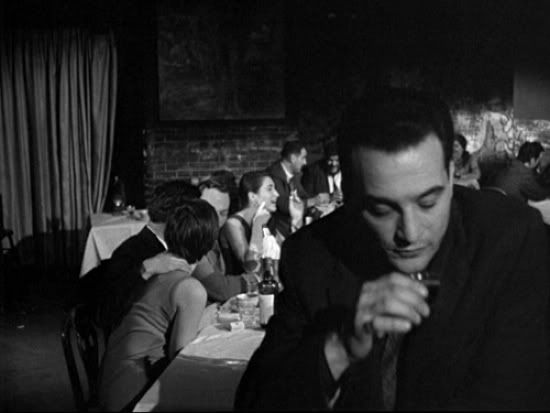
Clearly actor-director Allen Baron, knew what kind of film he was making with Blast of Silence (1961): A cheap but competently professional crime film suitable to be a calling card in the feature film business. An independent film scene was developing in New York at the time, most famously culminating in the films of John Cassavetes and Shirley Clarke. The resulting films are mostly theatrical in origin (not based on plays, but using the personnel and techniques of theater, especially improvisation), self-conscious and relating to the edgier aspects of downtown New York life--jazz, interracial love, gangs, drug addiction.
Blast of Silence is not having any. In fact, Frank Bono (pronounced "bon-no") might like to be part of the downtown scene. He might like to be part of any scene. But he's from out-of-town, he's alone for the Christmas season, just here to execute a hit and split. Forget all those depressed hippies, Bono is the definition of alienated.
I haven't actually been hired to kill someone (yet), but I have been alone in a city for a number of days at a time, and the film captures the boredom and isolation of that situation. And when Bono does have the opportunity to reach out to someone else he fumbles it. Which makes his own death logically right. Zero minus zero, nothing lost, the universe is still in balance. Barron's non-acting suits this perfectly. (Peter Falk, originally cast, would have been terrible, too ingratiating, too needy. Barron is a cipher, albeit an unhappy one.) The overwritten second-person narration (reportedly by a blacklisted Waldo Salt) is irritating at first, but you learn to tune it out--I almost wish Criterion could issue a version of the film without it.
A great deal of the contemporary pleasure of this film is seeing the New York locations, the Village, 125th Street, Rockefeller Center as they looked in the very early 1960s--some recognizable, some not. Shooting quick and dirty on the streets of the city means you don't have to actually have a cinematographic style. Those brightly lit yet dingy streets give you a production design and a shooting style by themselves--foreground objects and low key lighting not necessary (as Sweet Smell of Success demonstrated). Although there is an awe-inspiring shot as Barron approaches us from a long perspective, tiny at first, then filling the frame (my guess is it's East 34th Street near that large diagonally-placed building that sits on the corner of 34th and Park.)
Barron doesn't seem to have a great psychological or sociological point. It's a simple tale, crisply told. The best-laid plans and all that. The points make themselves via the pictures. And this Blast of Silence might be the last pure blast of noir before self-consciousness sets in.
As I write this post, the second sperm-donor-comedy is opening in theaters. (The Switch with Jennifer Aniston--don't look forward to a post about it.) The Book of Eli (2010) opened earlier this year as the second post-apocalyptic road movie, after The Road. Next to The Road's stripped-down elemental narrative of survival, The Book of Eli, with its action staging, dynamic protagonist and twist ending feels like Mad Max Goes to the Twilight Zone.
All of these films owe something to Sergio Leone, who took the vast and varied space of the American West, so dramatic and poetic in John Ford and turned into a blasted heath for an army of angry Lears to rail on. Strong, reticent heroes, reluctant to turn to violence until absolutely necessary, like Gary Cooper and Randolph Scott gave way to gun-toting sadistic psychopaths. For Washington and company, it's shoot first and ask questions later, strange for a character whose chief function in life is to safely transport a copy of the Bible. Sure, we had bible-thumping psychos before, most notably Robert Mitchum in Night of the Hunter. But he was the villain and an obvious hypocrite. Denzel is a sympathetic hero.
And what's with the religion thing? In a John Ford western, the church and the schoolhouse arrive with womenfolk, the end of the frontier, and the beginning of family life, stability, order. In Eli, the Bible introduces further mayhem, jealousy and covetousness.
The movie is one of those Sixth Sense deals that has an outrageous twist at the end that changes everything that went before it. Sixth Sense played by the rules. A second viewing reveals taht it never violated the story point that was revealed at the end. But although I have no desire to watch Book of Eli again to verify it, I am fairly sure that a number of the events and scenes in the movie are impossible or at least ridiculous in light of the final story twist.
It's not surprising given that this is also one of those movies that is so extensively treated in post-production--color drained, background elements CGI-ed in, that nothing in the film can be believed or trusted. And that is what is most disturbing about the fantastic possibilities of post-production CGI--nothing can be trusted, nothing can be relied on. If live-action film becomes no more convincing of its own reality than a fully-animated film, then why bother with it at all?
Taste of Cherry (1997) could be titled "Several Conversations About The Same Thing," but that would make it sound tedious, when it is instead strangely riveting. Perhaps it is the question itself, or the very fact of that question being posed in an Islamic context. The question: Can suicide be a positive good? Obviously, the Qu'uran answers with a clear "no," clearer even than Judaism or Christianity.
But even more strangely riveting is the way these conversations are conducted. We are not sitting at a table as in My Dinner With Andre, nor trapped in a radio station as in Mother Ghost. Instead, the protagonist, Mr. Badii is driving around Tehran and environs in his Range Rover, meeting people and giving them rides as he asks their help with his suicide. The crunch of the gravel under the tires, the turn of the steering wheel, Badii's searching gaze, lend a hypnotic rhythm to his quest. Writer-director Abbas Kiarostami eschews hand-held, subjective or any sort of experimental shots in favor of rock-steady, smooth motion. Even Badii's careful hand-over-hand handling of the wheel contributes to an air of calm contemplation.
Although this film is cited as an inspiration for Goodbye Solo, it has nothing in common with it other than a car and thoughts of suicide. Whereas the would-be suicide in Solo has made his decision, and settles into a sour funk, Mr. Badii is on a spiritual quest, albeit one with a possibly negative conclusion. But Mr. Badii does not offer a reason for his desire to end his life, he shows no bitterness, exudes no air of failure or disappointment. He seems in search of a higher purpose to the ultimate act of negation.
He meets a number of other men in this journey, all of whom are engaged in significant work, even if it is dull or repetitive. All are making a contribution. The most engaged is the Turk, Mr. Bagheri, who works with his hands and appreciates the palpable physical pleasures that, to his way of thinking, God has made for his children to enjoy. And those joys should be enough, given that any pleasure, probably savored, bespeaks infinity. As seen in the illustration above, Mr. Bagheri's care for other people and appreciation of life seem to earn him entrance to the gates of Heaven. (They're actually the gates of the university, but I'll take a visual metaphor where I can get it.)
The film does not conclude, but merely stops, borrowing a Brechtian trick seen before in films such as O Lucky Man!, The Imposters, The Maids and even the films of Mel Brooks. I have no idea what it is supposed to mean in this context, but it is disappointing, because until then, Kiarostami was on the path to achieving the impossible, making a film, not of a story, but of the process of thinking and of making a decision.
And if this film depresses you, and it shouldn't, just swipe a plum from the fridge. There it is, all the goodness of the world. So sweet and and so cold.
For a film about the development of trust, The Girl With The Dragon Tattoo (2009) doesn't trust its audience very much. It turns out the lights, turns up the music, and bangs us over the head with some of the most grotesque and nauseating personal violence ever seen in a mainstream movie. It purports to condemn violence against women, then serves up a big steaming bowl of it, including attacks on and by the title character (who is not the central character).
Most of the film occupies that newly-established place bridging mystery, thriller and horror film, pioneered by Silence of the Lambs and continued with 7even. The addition of horror elements means not only horrific depictions of the murders, previously only described in more polite mysteries, but also violence upon one or more central characters, and thereby to be experienced by the audience.
That accretion of new genre conventions is almost necessary, because once the audience is past the preliminary investigation into piles of original documents and photos, the principal mystery becomes fairly easy to guess--I did so, and I'm terrible at solving mysteries. Thus, the final bursts of violence are perversely welcome after a long becalmed period, incorporating an improbably romance between the protagonist, a middle-aged reporter and the title character, a badly damaged young woman who has discovered a talent and passion for hacking. After that, there is a very limp resolution of the "outer" plot, in which the inner story has been nested. Thus, Dragon Tattoo has some unintended common ground with Inception, in their mutual Russian-nesting-doll structure.
The trust trope is thoroughly infused into the narrative: most institutions in this universe betray and degrade the people they are meant to serve. Government employees, businessmen, guardians of minors, lovers, fathers, brothers--none of them are trustworthy. It's a miracle that Blomqvist or Lisbeth can look anyone in the eye. And although the romance does not necessarily pan out, it's very existence, though brief, is a spiritual triumph.
The color palette is washed out as is de rigeur these days to indicate "atmosphere," and the production design is oppressively drab. Presumably this was deliberate--everyone seems desperate to find happiness or joy in this very bleak world. This movie's going to kill Swedish tourism.
Finally, although this is not a reflection on the film itself (which is what I try to confine myself to), one must applaud the producers' boldness in committing to filming the entire trio of mysteries at once. The Americanized version will not be done that way--there will be a slow, tentative stab at the initial installment, then a reluctantly made decision to go ahead, by which time the original actors and/or director will not be available, or perhaps the series will be abandoned incomplete due to the natural gutlessness of the American film finance market.
And will the villains in America be Nazis? That does not have the resonance in the States that it has for Europeans, who were faced with the actual option to join the party. American Nazis are fringe cuckoos. European Nazis could be either evil or careerists (like Herbert von Karajan).
But then driving out ambiguity is what American mainstream filmmaking is all about. At least they hired David Fincher for the remake, so we can hope.
This is the film blog I began to provide a model for my Film Studies students and encourage them to maintain a blog of their own. I no longer write about every film I see, but I try to take note of the unusual, the remarkable, the strange or interesting connections.
Please comment copiously!Or write to me directly at my e-mail address.




 Posts
Posts


